National Recovery Guidance: common issues
Guidance primarily aimed at local responders covering some common issues that may arise during the Recovery Phase of an emergency in the UK.
Recovery structures and processes
Recovery is a complex and long-running process that will involve many more agencies and participants than the response phase. It will certainly be more costly in terms of resources and it will undoubtedly be subject to close scrutiny from the community, the media and politicians alike. It is therefore essential for the process to be based on well thought out and tested structures and procedures for it work in an efficient and orderly manner.
Policy and guidance
England
Non-statutory guidance on the multi-agency structures and processes that can be used during the recovery phase is given in ‘Emergency response and recovery’. However, recent emergencies have shown that local responders would benefit from access to more detailed guidance, hence the production of this National Recovery Guidance.
In addition, responders have indicated that having access to a generic recovery plan template would also be of assistance as they take forward their recovery planning. In light of that, a ‘Recovery plan guidance template’ has been drawn up using examples from many existing local authority recovery plans and the experience of those affected by events such as severe flooding and other major emergencies both in the UK and abroad.
The template provides generic guidance to assist in the recovery phase of emergencies. Depending on the scale or nature of the emergency, some parts may not be relevant and a flexible approach both to the emergency and recovery is needed. It is also important to bear in mind that if the event is regional or sub-regional in scope, this plan must, by necessity, be a part of the wider recovery process. Reference should be made to the contents of the Community Risk Register when producing the plan to ensure it reflects the hazards and threats in the local area.
The template has been developed to enable it to be adapted for use at different levels, - on a regional, local resilience forum (LRF) or local authority geographic footprint. Users can extract whatever content they feel is appropriate to their particular needs. For example, users may wish to develop a local authority-based generic recovery plan, and/or an LRF-based generic recovery plan, or incorporate a recovery chapter in an LRF-based generic major incident plan. There are no rules as to which approach should be taken, so long as:
- the resulting plan(s) is seen as fit-for-purpose by those multi-agency local responders who will need to use them
- plans are scalable and complementary, for example, if an emergency covers a wide area, all the recovery plans (and the structures and processes contained in them) must be capable of operating seamlessly, side by side, so the service provided to the affected community is consistent and joined-up
The template explains:
- the differences between response, recovery and regeneration, recognising there is often an overlap between them; the recovery process should start as soon as possible after the initial response, and run in parallel with it, until the formal handover from response to recovery takes place
- the purpose and principles of the recovery process
- an outline recovery strategy
- the various impacts that an emergency may have and the methodology of an impact assessment
- guidelines on handover from the response to the recovery phase
- a suggested structure diagram of a recovery co-ordination group (RCG); his is backed up by suggested terms of reference, group membership, and lists of potential issues for the RCG and its various sub-groups to consider
Wales
The template is equally applicable to Wales, where similar structures exist at the local level. However, responsibilities devolved to the Welsh Assembly must be taken into account in recovery planning.
Scotland
[TBC]
Northern Ireland
The principles and guidance set out above are relevant to Northern Ireland. However, the statutory and organisational context is different. ‘A guide to emergency planning arrangements in Northern Ireland’ and ‘The Northern Ireland civil contingencies framework’ set out contingency planning, including recovery planning arrangements for Northern Ireland.
The Local Government Emergency Management Group publication, ‘The role of district councils in emergency planning and response: support to other organisations’ provides information on some local recovery arrangements.
Roles and responsibilities
Local and regional - emergencies within one local authority’s boundaries
The local authority is the agency responsible for planning for the recovery of the community following any major emergency, working closely with other local and regional partners via the resilience forums.
Following an emergency, it will usually co-ordinate the recovery process, including by chairing and providing the secretariat for the RCG, with support from the full range of multi-agency partners as necessary. The recovery plan template provides details of those other multi-agency partners who may be involved in recovery and outlines their roles and responsibilities.
Local and regional - emergencies crossing local authority boundaries
When carrying out their recovery planning, local authorities, along with their local and regional resilience forum partners, need to agree how they would co-ordinate the recovery from emergencies that cross local authority boundaries. The agreed arrangements need to be detailed in the relevant local and regional plans.
Where the emergency crosses a local authority boundary but remains within one LRF area, the affected authorities will need to decide whether to establish one recovery co-ordination group (RCG) at the LRF level, or whether to operate separate RCGs in each local authority area. To ensure there is consistency of approach, no duplication of effort, and to reduce the burden on agencies that cover more than one local authority area, the recommended approach would be to have 1 RCG to cover all affected communities within the LRF area. In this instance, it would be sensible for the affected local authorities to designate a lead local authority that would provide the RCG chair and secretariat. Other local authorities could then provide deputy chairs as necessary.
Where the emergency crosses LRF boundaries, consideration should be given to the potential assistance that the Regional Civil Contingencies Committee (RCCC) could provide in ensuring consistency of approach, reducing duplication of effort, minimising the burden on responders, and facilitating the sharing of information, support and mutual aid. Reference should be made to the relevant generic regional response plan for details of how local authorities are represented at RCCC meetings.
Lead government department
In an event requiring national level recovery structures to be activated, the Civil Contingencies Secretariat (Cabinet Office) will decide the lead government department, based on the type of emergency.
The regional resilience team in the relevant government office will provide the conduit for communication with the nominated lead government department.
Other government involvement
Other government involvement in national level recovery structures will depend upon the specific emergency. Responsibilities will lie where they fall.
Devolved administrations
Where emergencies cross government (or in the case of Northern Ireland, country) boundaries, it is clearly still vital that recovery efforts are co-ordinated. However, it should be recognised that different legislation and funding streams, as well as different structures, may be in place in the devolved administrations. These are outlined further on in this guidance. Areas that border devolved administrations are encouraged in the planning phase to agree how recovery would be co-ordinated in cross-government boundary incidents and record this in the relevant local and regional plans.
Within the devolved administrations, the same recovery co-ordinating groups would be established. Equally, in place of RCCCs, the devolved administrations could establish their equivalents (Wales Civil Contingencies Committee for Wales, TBC for Scotland, TBC for NI) to fulfil the same role.
Wales
Many aspects of recovery fall within the devolved responsibility of the Welsh Assembly government in Wales, which will therefore act as the lead government department in those instances.
Scotland
[TBC]
Northern Ireland
Recovery planning for local emergencies would fall to district councils and other local organisations. For civil contingencies purposes Northern Ireland district councils (other than Belfast City Council) work in groups. The local government emergency management group (LGEMG) co-ordinates civil contingencies activities across district councils and other organisations. Arrangements are in place for councils to decide quickly on a lead council for local emergencies which cross council or group boundaries.
District Councils which border the Republic of Ireland have arrangements with local authorities across the border for dealing with any local incidents which cross the border.
In emergencies with a regional dimension a lead government department or the Northern Ireland central crisis management machinery would co-ordinate response and recovery, although local organisations would still have a significant role to play at community level.
In regional emergencies with a cross border dimension, the Northern Ireland Executive would work closely with its counterparts in the Republic of Ireland to ensure a co-ordinated approach to response and recovery.
Funding
Local authorities are expected to fund and carry out recovery planning through their normal emergency planning workstreams.
Case Studies (Incidents and Exercises)
Other Useful Documents
Focus on Recovery: A holistic framework for recovery in New Zealand
List of Contacts
[TBC]
Training and exercising
Background and Context
Emergency Preparedness makes clear the need for training key staff to obtain the necessary competence (which is a combination of knowledge, skills, and attitudes) as well as running exercises to test the robustness of plans. The distinction lies in differentiating between the competence of responders and the effectiveness of the plan so that these can be assessed.
Training for the recovery phase and validating the arrangements through exercises is less developed than our ability to train and exercise for the response phase of an emergency. However many of the processes are the same, it is just that the context is different, often delivered over a much longer time line, and involves a wider group of stakeholders.
National Occupational Standards (NOS)
National Occupational Standards (NOS) describe competent performance in terms of outcomes of an individual’s work and the knowledge and skills they need to perform effectively. The NOS for Civil Contingencies allow a clear assessment of competence against nationally agreed standards of performance, across a range of workplace circumstances for those involved in resilience and civil protection. For further information, please visit www.skillsforjustice.com.
Core Competences Project
The Core Competences Project was initiated as a joint venture between the Cabinet Office Emergency Planning College and the Emergency Planning Society. One year into the Project it was announced that the Sector Skills Council for Justice would be leading a project to develop NOS in Civil Contingencies. Consequently, it was agreed that Skills for Justice would work in partnership with the Project and as a result the NOS for Civil Contingencies form the foundation of the Core Competencies Framework.
The resulting Framework has been designed to cover those areas that are considered to be essential to the practice of emergency management. The eight technical areas of the NOS for Civil Contingencies which form the foundation for the Framework have been extended to include four further areas of competence:
- theories and concepts in emergency management
- acting effectively across your organisation
- debriefing after an emergency, exercise or other activity
- managing computer generated data to support decision making
Policy and Guidance
England
Firstly, to clarify the distinction between training and exercising - Emergency Preparedness suggests:
Training, as such, as distinct from exercises, is broadly about raising the awareness of the participants (who are those named in the plan or mobilised by it) about what the emergency is that they may face and giving them confidence in the procedures and their ability to carry them out successfully. It is particularly important that participants in training understand the objectives of the plan and their part in achieving them. [Paragraph 5.134 of Emergency Preparedness]
Generally, participants in exercises should have an awareness of their roles and be reasonably comfortable with them, before they are subjected to the stresses of an exercise. Exercising is not to catch people out. It tests procedures, not people. [Paragraph 5.143]
Having made the distinction above, there is an overlap between the two:
Exercises have three main purposes:
- to revalidate plans (revalidation)
- to develop staff competencies and give them practice in carrying out their roles in plans (training)
- to test well established procedures (testing)
Most exercises will have some elements of all three. [Paragraph 5.144]
Training
In order to develop a Recovery capability, it is essential that roles, responsibilities and procedures have been identified and that the people involved have the necessary competence. Competence can be defined as having the appropriate knowledge, skills, and attitudes (KSA). The level of competence needed has to be defined, then an assessment carried out of what level of competence the people responsible for delivering the capability currently have. This process is called a Training Needs Analysis, and should follow the same approach as that which is used to identify training needs for the response phase.
The stages involved in a Training Needs Analysis are:
- Detail what is needed to deliver the capability.
- Detail who is responsible for delivering the Recovery capability in terms of organisations and positions / roles within it. This should flow from the multi-agency Recovery Plan and include Category 1 & 2 responders, plus anyone else needed to deliver the capability including members of the voluntary and private sectors.
- Detail what competences (KSA) these different people need in order to deliver the different elements of the capability including planning for and implementing the Recovery plan. Also include the competences they need at the individual, team and multi-agency level.
- Assess current competences and current training provision (including exercising, guidance, literature, etc. and training providers). Having completed stages 1 – 3 above, what competences are needed and by whom should be apparent. This will enable questions to be designed to assess current competence in the areas required. Current competences and current training provision can be identified through a number of methodologies such as:
- questionnaire – sent to people involved in preparing for and delivering the capability
- focus groups (facilitated sessions using people from different levels and different organisations)
- structured interviews (1 to 1) with policy leads and / or operational staff
- unstructured interviews with experienced personnel to gather more thoughts / suggestions / clarification
The competences required during the recovery phase are more likely to be aligned to the day-to-day role of responding staff. For example, in dealing with people made homeless during an emergency, it is expected that local authorities will primarily use staff that deal with homelessness issues on a daily basis – albeit maybe not to the scale or in the timescales expected following an emergency. This approach to allocating people to tasks not only effectively builds on their existing knowledge of the subject area, but also enables them to use their probably well developed network of contacts both within the local authority area and further afield, which may be particularly helpful if mutual aid is required.
Exercises
Whilst there is generic guidance in Emergency Preparedness and the Home Office Exercise Planning Guide on designing and running exercises, there is no specific guidance on exercising the recovery phase.
The Civil Contingencies Secretariat is currently developing and bringing together a range of exercises, guidance and support tools [‘tools’ here is meant in the broadest sense, meaning specific tools and techniques and more general frameworks and guidance] which could be used to assist organisations in exercising recovery and which may then be used to inform planning for recovery.
The tools are designed to provide support and accompanying materials to facilitators in exercising recovery. Completed documents and tools can be found below.
Partner exercise: Click on the hyperlinks below to access material for using the Partner Exercise:
The tools here form part of a planned wider package which will be used to provide further guidance on exercising recovery. Further tools will be added to this site. These will include, amongst others, suggested injects and scenarios for a recovery exercise, and decision tools.
These tools have been developed by the Civil Contingencies Secretariat, with the assistance of the Recovery Exercising Advisory Group (REAG). REAG consists of representatives from:
- Communities and Local Government
- Coventry City Council
- Emergency Planning College
- Environment Agency
- Essex Fire and Rescue Service
- Food Standards Agency
- Government Decontamination Service
- Government Office North West
- Health Protection Agency
- Lancaster University
- Local Government Association
- North Wales Resilience Forum
If you wish to be involved in this Group or for more information on this work, please contact recovery@cabinet-office.x.gsi.gov.uk.
Many organisations have run recovery exercises. Case studies from recovery-related exercises can be found at the bottom of this page. The learning from these has shown that:
- In light of the cross-cutting nature of recovery, as wide a range of participants as possible should be involved in recovery exercises. This will go beyond the usual ‘resilience family’, and may include bodies such as Local Enterprise Partnerships (LEPs), Tourist Boards, Chambers of Commerce, Natural England, or English Heritage (and devolved equivalents in devolved areas), as well as community groups and faith leaders, and possibly even individual businesses. Similarly, other wider representatives from Category 1 and 2 organisations, such as Social Services and Elected Members from local authorities, should also be encouraged to attend. Invitation lists can be compiled based on those organisations detailed in the Recovery Plan. It is important that exercises are written to cover issues relevant to all organisations present, or else attendees may feel they have not benefited from attendance, and it may be difficult to obtain their input at future events.
- It is difficult to reflect the true nature of recovery in an exercise, as exercises normally only last for a day or two, whereas the recovery phase itself can of course last for one or two years. There are a number of ways in which this can be overcome, for example:
- by holding a number of exercises to represent various stages of the recovery phase. These may be split by time (eg. starting at day 5 after the emergency has occurred, then jumping to 2 weeks after the emergency, then 2 months, and so on), or by key milestones (eg. prior to clean-up, once clean-up is complete, etc).
- by running one exercise but using ‘time-lapse’ at points during the day. Again, the exercise can be split by time or key milestones.
- Whatever approach is used, there needs to be comprehensive pre-start briefing which summarises the scenario to date and the decisions that have been made in the response phase. This will help ensure that people do not become focussed on response issues during an exercise that is supposed to be focussed on recovery. Consideration should therefore be given to running recovery exercises on the back of response exercises to avoid this tendency taking place.
- There is considerable benefit in exercising the handover phase from response (Strategic Co-ordinating Group) to recovery (Recovery Co-ordinating Group) so that the criteria that would be used to determine the right time for handover to take place and the handover processes themselves can be tested. This aspect can clearly be covered in both response and recovery exercises.
- As with response exercises, the scenarios used in recovery exercises should be prioritised in line with the key risks in the Community Risk Register. However, Local Resilience Forums may wish to ‘tweak’ scenarios to ensure they test out those particular aspects of recovery which have been found to be weak / a gap in incidents and exercises elsewhere.
- The use of scenarios that result in recovery co-ordination being required across local authority / LRF boundaries are encouraged in order to test out the effectiveness of cross-boundary recovery structures and processes.
- Testing mutual aid arrangements, particularly between local authorities, is beneficial.
- Issues identified in recovery exercise debrief reports that would be of interest to partners outside of the LRF area should be shared with Regional Resilience Teams (or devolved equivalents) for wider dissemination.
Wales
The Wales Resilience Forum is overseeing the development of a Wales exercise and training programme through its multi-agency Wales Training and Exercising Group. A central training fund has been established for pan-Wales training and exercising which is managed by the group.
All four Local Resilience Forums in Wales have exercised their recovery plans in recent years all of which have used a flooding scenario: Exercise Rufus (Dyfed-Powys), Exercise Rufus II (South Wales), Exercise Watertight (North Wales) and Exercise Ursula (Gwent).
Scotland
At a national level, the Scottish Resilience Development Service of the Civil Contingencies Unit is responsible for civil contingencies training and exercising. The Service has produced Scottish Exercising Guidance – July 2009 which provides generic guidance on exercise management and which aims to set out good practice for all forms of civil protection exercises in Scotland, including those that deal with recovery issues.
The Service has developed a system for exercise management, including a database of exercises available to registered users. For further information, see https://scords.gov.uk/.
Individual training for recovery management is primarily a matter for mainstream learning providers. For example, those carrying out environmental protection activities during the recovery process should develop their competence through mainstream environmental management training and development.
Collective training may be needed to ensure that teams are able to put their skills into practice in an emergency. Organisations that are members of Civil Contingencies Strategic Co-ordinating Groups are responsible for making sure team members are aware of their role throughout an emergency and have the opportunity to try out their skills, for example through exercises. Responder agencies may also use exercises to both evaluate arrangements and performance. Such exercises should follow normal good practice.
Northern Ireland
No differences for Northern Ireland.
Roles and Responsibilities
Local and Regional
Training of key staff is the responsibility of their respective organisations, although there is merit in considering the use of multi-agency training events to cover the various aspects of recovery.
Local authorities will usually lead on the development, implementation and debrief of recovery exercises, but this should be with the full support of all Local Resilience Forum members and wider partners.
Lead Government Department
Cabinet Office co-ordinate the cross-government exercise programme.
The Emergency Planning College – part of the Cabinet Office – run training events on recovery.
Other Government Involvement
Many departments who have a Lead Government Department role for particular capabilities / scenarios run national exercises. These have tended in the past to focus on the response phase of incidents, but departments have run some specific recovery exercises and the recovery phase can be built in to response exercises.
Regional Resilience Teams co-ordinate a regional exercise calendar. Recovery training and exercises should be fed into these programmes, as with all other Local Resilience Forum events, to avoid diary clashes and facilitate the identification of possible cross-LRF training and exercising opportunities.
Devolved Administrations
Wales
The Wales Resilience Forum oversees the development of a Wales exercise and training programme through its multi-agency Wales Training and Exercising Group.
Scotland
No difference
Northern Ireland
The Emergency Planning College has a new prospectus for Northern Ireland. The training is delivered locally by Emergency Planning Solutions who are accredited by the college to deliver EPC training within the Province.
Funding
The funding for any training is expected to be absorbed internally within the relevant organisation.
Recovery exercises are usually funded by the local authority, but contributions may be sought from all participating organisations.
Devolved Administrations
Wales
Funding of exercises at the local level in Wales is generally handled through the Local Resilience Forums. A central training fund has been established for pan-Wales training and exercising which is managed by the Wales Training and Exercising Group.
Scotland
[TBC]
Northern Ireland
[TBC]
Case Studies (Incidents and Exercises)
Other useful documents
- UK Financial Sector’s market-wide exercise 2009 final communiqué 4
List of Contacts
- The Emergency Planning College runs courses on recovery and is also able to offer further advice and guidance about developing and implementing a training strategy.
- Scottish Resilience Development Service
- Chartered Institute of Personnel and Development
- Emergency Planning Society Competency Framework
- National Occupational Standard
Data protection and sharing
Background and Context
Data protection and data sharing have long been issues for the public and private sectors. In a number of emergencies, problems, either perceived or real, surrounding interpretation of Data Sharing and related Human Rights legislation have prevented public bodies from carrying out their duties effectively. The Indian Ocean Tsunami, the Bichard Inquiry (into the Soham murders) and the Victoria Climbie Inquiry all identified areas of uncertainty in the interpretation and application of data protection and sharing rights and responsibilities.
Most recently, as part of the government’s lessons identified programme following the 7 July 2005 London bombings, it was found that limitations on the sharing of data between a number of Category 1 and 2 responders hampered the connection of survivors to appropriate support services. Subsequent investigation found that many of these limitations were self-imposed and resulted from incorrect application of duties perceived to be imposed on public organisations by the Data Protection Act and other legislation.
Data sharing within and between the public and private sectors, and between Category 1 and 2 responders, cuts across a range of scenarios and responsibilities – the duty to properly risk assess at local and regional levels; to construct effective and realistic emergency plans; during the response to an emergency; and to recovering from and managing the consequences of emergencies.
Policy and Guidance
England
The range of guidance available, reflect that this is an issue that cuts across all workstreams and the public/private sectors at national and local levels. Guidance touches on many roles and responsibilities, from legal powers of local authorities, to the detailed restrictions on the sharing of medical histories, through to the sharing of utilities data to aid in risk assessment.
- Data Protection and Sharing – Guidance for Emergency Planners and Responders
- Government’s Vision for Information Sharing
- The DCA Toolkit for Data Sharing and Data Sharing Library
- Information Commissioners’ Office (ICO)
- Data Sharing Review
Patient Confidentiality and Access to Health Records
There are significant differences between sharing certain types of personal data (name and address for example) and sensitive personal data (health details for example), and both the Cabinet Office guidance on data sharing in emergencies and DH guidance make this clear.
Recent experience has clearly indicated that compiled and refreshed guidance is needed. Both the Information Commissioner’s Office (ICO) and the Ministry of Justice are developing complementary guidance on data sharing and protection issues that takes account of experience, case history, and balancing the needs of the general public and public and private organisations.
Devolved Administrations
Data sharing is a pan-UK issue. The Data Protection Act itself applies to the entire UK. The Civil Contingencies Act covers the UK, but with differences in the responsibilities placed on devolved administrations. However, the underlying principles of a pragmatic, sensible and balanced approach to data protection and sharing are universal.
Roles and Responsibilities
Local and Regional
Category 1 and 2 responders have a duty under the Civil Contingencies Act 2004 to share information to aid resilience planning, response and recovery. This obviously necessitates an understanding of the relevant legislation and the responsibilities of those requesting and those providing information. Both public and private sector organisations are bound by the Data Protection Act and related legislation.
Lead Government Department
In relation to enhancing resilience capabilities, data sharing comes in two parts – pre-emergency, mainly for planning purposes, and post-emergency, mainly for providing support services. The Lead Government Department indicated below can offer advice where relevant, but in an emergency, responders should be prepared to make a decision without formal advice.
The Lead Government Department for the Data Protection Act and the Human Rights Act is the Ministry of Justice.
The Information Commissioner’s Office (ICO) is the independent authority set up to promote access to official information and to protect personal information. The remit of the Information Commissioner includes the Data Protection Act and the Freedom of Information Act amongst others. Whilst their main role is to protect and promote the public’s interests, the ICO can offer a view on specific cases.
Other Government Involvement
Cabinet Office (in the form of the Civil Contingencies Secretariat - CCS) co-ordinated the publication of Data Protection and Sharing – Guidance for Emergency Planners and Responders, and are owners of the lesson identified from the 7 July London attacks. Information relating to the Civil Contingencies Act and information sharing can be found on the Information and Data Sharing page.
Case Studies (Incidents and Exercises)
List of Contacts
- The Ministry of Justice helpline to answer urgent queries on the Data Protection and Human Rights Acts is 020 7210 8034 or www.dca.gov.uk/ccpd/lcdcontacts.htm
- Information Commissioner’s Office for online enquiries Helpline 01625 545745
- Civil Contingencies Secretariat
Mutual aid
Background and Context
Successful response to emergencies in the UK has demonstrated that joint working and support can resolve very difficult problems that fall across organisational boundaries. Large scale events have shown that single organisations acting alone cannot resolve the myriad of problems caused by what might, at first sight, appear to be relatively simple emergencies caused by a single source.
Mutual Aid can be defined as an arrangement between Category 1 and 2 responders and other organisations not covered by the Act, within the same sector or across sectors and across boundaries, to provide assistance with additional resource during an emergency, which may overwhelm the resources of an individual organisation [Emergency Response and Recovery].
Civil Contingencies Act
Bi-lateral and Cross Border Co-operation
Although the Act lays down duties regarding bi-lateral co-operation, that should not be seen to restrict responders working closely together outwith its provisions. For example, it would be anticipated that adjacent local authorities in differing police force areas would co-operate in matters of mutual interest in the same way that their respective SCGs/LRFs would. In this way, good practice can be identified and shared across boundaries.
Joint discharge of functions
In some instances, Category 1 responders may wish to go beyond bi-lateral co-operation and enter into formal joint arrangements with other Category 1 responders. Care should be taken to ensure that joint arrangements have taken into consideration the needs of all partners which might have an interest in the arrangements being made. Failure to accommodate the needs of all partners will prove both wasteful and inefficient, and ultimately will undermine the benefits of local partnership working.
UK Policy and Guidance
While there is no UK wide policy specifically relating directly to mutual aid, many areas such as police, fire, NHS and local authorities have inter (and intra) agency mutual aid protocols in place. Most of these are formal, but many are informal.
Formal protocols detail how each partner will undertake or allocate responsibilities to deliver tasks. Protocols may cover matters of broad agreement or details for working together, including how to hand over tasks or obtain additional resources. Protocols may or may not be legally binding depending upon the nature of the agreement between the parties.
The Local Government Association and Civil Contingnencies Secretariat are currently undertaking a project to provide support and guidance to enable local authorities to develop effective mutual aid arrangements. This work will be informed by the Sir Michael Pitt Flood Review. More information on the project’s outcomes will be made available as the project progresses.
A significant part can be played by the voluntary sector and others - partnerships may also embrace a wider group of organisations at the appropriate level. For example, WRVS and the Red Cross may work with local authority social services to open rest centres and deal with the needs of displaced people, and local businesses might work with the emergency services regarding evacuation plans for a shopping centre. The National Voluntary Sector Civil Protection Forum, in partnership with the Civil Contingencies Secretariat, has produced a , which provides some suggestions to support Category 1 responders’ and their voluntary sector partners’ work when considering collaborative arrangements.
Local emergency plans should take into consideration the possible requirement for assistance which may be outwith the local government sphere and these should be fed into the plans themselves. As well as the voluntary sector, there may be a need to work with other organisations such as utilities and transport providers, and it is good practice to make contact with these organisations and maintain links with them to make the contact easier in the event of an emergency.
Local authority mutual aid guidance
The Civil Contingencies Secretariat in collaboration with the Local Government Association (LGA) and the Society of Local Authority Chief Executives and Senior Managers (SOLACE) has produced a short guide to support local authorities in developing effective mutual aid arrangements. The guide offers advice on a range of practical considerations and provides a general framework that can be developed by authorities to satisfy local requirements. Publication of this guide meets Recommendation 38 of Sir Michael Pitt’s report on the 2007 floods.
Mutual Aid - A short guide for local authorities
Co-ordinate Offers of Material Help
It is likely that many offers of help will arrive from the general public, businesses, charities, voluntary agencies and others both during the response and recovery phase. Some will be of practical assistance, others goods for those directly affected.
Consideration should be given to:
- procedures to register and co-ordinate offers of help
- forming a panel to assess needs and the distribution of donated help
- identifying storage areas
- a disposal mechanism for unused donations
Roles and Responsibilities
Local and Regional
Local Resilience Forums (LRFs) ensure effective delivery of those duties under the Civil Contingencies Act that need to be developed in a multi-agency environment including the recovery aspects. LRFs can also facilitate the provision of formal mutual aid agreements between its members.
Regional Resilience Forums (RRFs) can also be used for facilitating wider mutual aid agreements, eg. between all Local Authorities in a region.
Mutual Aid arrangements exist within and between many of the voluntary sector organisations, for activation as required, particularly across boundaries. In the event of a major or international emergency, voluntary sector support may be accessed through the head offices of the relevant voluntary organisations or through the Voluntary Sector Civil Protection Forum or the National Voluntary Aid Society Emergency Committee (NVASEC).
Links with the voluntary sector will normally be co-ordinated through the Local Authorities in an area - often through a sub-group of the Local Resilience Forum – and activation and co-ordination arrangements for voluntary sector involvement in both response and recovery phases should be formalised as part of emergency planning work.
Lead Government Department
There is no lead Government Department for the co-ordination of mutual aid arrangements, although dependent on the emergency, it may be possible for the relevant government department to assist with the facilitation of mutual aid.
Other Government Involvement
Departments involved will be determined by the type of incident that has occurred.
Devolved Administrations
Scotland
Strategic Co-ordinating Groups are established in each of the Police Force areas and include amongst their roles, to ensure co-operation, mutual assistance and support for local responders. Where an emergency demands significant police involvement, the Scottish Police Information and Co-ordination Centre (S-PICC) can be activated to support SEER by collecting information from Scottish police forces, and to co-ordinate mutual aid between police forces.
Wales
As in England, the LRFs can oversee the provision of formal mutual aid agreements between their members whilst the Wales Resilience Forum can facilitate such arrangements on a broader basis.
Finance
Detail on the financial implications of any mutual aid agreement should be determined between the parties and set out within the protocol.
Case Studies (Incidents and Exercises)
Other Useful Documents
There are many examples of mutual aid protocols available. Below is a selection:
- Fire Service National Mutual Aid Protocol for Serious Incidents
- British Transport Police and Scottish Police Forces Policing Protocol
- Co-ordinated Policing Protocol between the British Transport Police and Home Office Police Forces
Military Aid
Background and Context
Whilst the Armed Forces have provided ad-hoc assistance to the civil authorities on all manner of occasions over the years, resilience planners must not assume that such support will be available in the future when developing their capability programmes. Military support is provided on an assistance basis and a variety of factors means that it cannot be guaranteed.
The Ministry of Defence has a share in the wider Government responsibility for the safety and security of the citizens of the UK. That contribution, however, rests crucially on its ability to undertake expeditionary operations, including the ability to undertake expeditionary counter terrorist operations and capacity-building. The security of the UK depends on the Armed Forces ability to undertake such tasks, and operations in the UK must therefore be regarded as exceptional and unusual. Military Assistance to the civil Authorities (MACA) can, however, make a significant contribution at times of extreme crisis, and the Armed Forces will remain prepared to respond to some emergencies in the UK, especially where Defence can achieve a strategic effect. Defence will continue to work to enhance and support the capability, capacity and confidence of civil agencies in responding to such challenges with the minimum of disruption to the lives of the ordinary citizen.
During a Recovery/consequence management operation the provision of Armed Forces’ support will require the approval of a Defence Minister following the receipt of a formal request by a government department
Policy and Guidance
The Armed Forces remain heavily committed to operations overseas and are likely to remain so for the foreseeable future. Those parts of the Armed Forces that are not currently employed on operations overseas are largely preparing for, or recovering from, such operations. There is little spare capacity to carry out additional tasks.
The framework for MOD involvement in the consequence management of civil contingencies in the UK is therefore one of civil primacy, civil capability and civil capacity. Case-by-case assistance to the civil authorities is possible through the Standing Home Commitments Group of Military Tasks but resilience and recovery planners must understand that planned Defence contributions at home are very much by exception, in particular where it is unreasonable or unrealistic to expect the civil authorities to develop their own capabilities.
If available, Defence capabilities held for overseas tasks may be called upon to support the Civil Authorities providing there is no civil alternative; if the capability and/or capacity of the civil sector is overfaced; and they do not duplicate the efforts of other agencies and departments.
The Armed Forces have provided assistance on this basis to a number of other Departments and Agencies over the years and can be called upon in extreme and unusual circumstances to provide support to the civil authorities. However, historical evidence of Defence assistance for a particular role is no justification for similar requests. Moreover, it should not be planned for the Armed Forces to fill gaps in civil capability or capacity: where a gap in civil capability can be identified in advance, it is for resilience planners to fill that gap.
It is accepted that during an emergency, unforeseen failures of the resilience plan or events in excess of planning assumption, will generate requests for Military aid. Planners should bear in mind that Defence’s priority will be focused on delivering Defence outputs. Any requests will be scrutinised in terms of Military capability and capacity available and whether the actual request is a good use of Military assets - a positive response is not guaranteed. For instance, should Defence contribute to the delivery of security and public order or should they be utilised for municipal tasks; this will be a decision for ministers.
Armed Forces support to civil resilience can be divided into two categories:
- Niche capabilities. Where, in the view of Defence Ministers, it is in the national interest to devote specific Armed Forces and MOD assets to specific operations in the UK, either in whole or in part. These assets are identified in Defence Planning Assumptions and are guaranteed. They include: * a UK-based and UK-focussed Command and Control structure * a UK focused Defence communications capability * an Explosive Ordnance Disposal and Chemical Biological Radiological and Nuclear make-safe capability * an air surveillance, policing and defence system * Fishery Protection vessels * a Special Forces capability * a Search and Rescue capability
- Augmentation Capabilities. When civil contingencies arise, it is possible to deploy the armed forces in support of the civil authorities if Defence Ministers consider it appropriate. Resilience planners should not make assumptions about the criteria that might influence a Defence Ministers decision in advance and should not make assumptions about the level of military deployment. Defence Ministers will only be able to draw on the forces available at the time and this will depend on the degree to which the regular and reserve forces were committed overseas. However, it is safe to assume that deployment of the Armed Forces in this role would not normally be considered unless the deployment was required to make a strategic impact on extreme and unusual circumstances.
The legal basis for instructing Armed Forces personnel to provide support to the civil authorities in the UK can only be one of the following:
- Section 2 of the Emergency Powers Act 1964 (plus the Emergency Powers (Amendment) Act (Northern Ireland) 1964) which enables the Defence Council to issue instructions to undertake ‘work of urgent national importance’
- Part 2 of the Civil Contingencies Act 2004 which enables the Queen or a Senior Minister, in particular circumstances, to issue emergency regulations which can in turn enable the Defence Council to deploy the Armed Forces
- tenet of common law indicating that citizens should provide reasonable support to the police if requested to do so. All members of the Armed Forces have a duty to provide the support normally expected of the ordinary citizen. The same common law tenet enables a Defence Minister to direct the Armed Forces, on a case by case basis, to provide specialist support to the police
Military units and personnel remain under the MOD chain of command at all times and are not subordinated to the command of civil authorities.
Devolved Administrations
Provision of MACA remains a central issue.
Roles and Responsibilities
Local and Regional
Personnel of the police and other civil agencies are granted special powers unique to them. To ensure that they are even-handed in the application of these powers, they are operationally independent of Government. Local agencies have the authority to institute local responses.
The Armed Forces are not independent of Government and Armed Forces personnel do not have additional powers granted to them. They remain under Central Government control at all times and only Defence Ministers can authorise their deployment, for any purpose. Support to the civil authorities cannot be provided without this authorisation. This also means that provision of Military Support automatically involves the elevation of the response to central Government.
In the first instance, guidance on requesting military aid for recovery situations should be sought from the Joint Regional Liaison Officer (JRLO) who is a key member within the LRF / RRFs. The JRLO can then liaise with the appropriate Defence Organisations to seek further advice. JRLO liaison involves the provision of advice and the exchange of information. It does not guarantee the provision of support. However, any formal request must be made through the appropriate Government Department or Agency who will then approach the Ministry of Defence directly. It is worth noting that the armed forces are more likely to be engaged in the response to, rather than the recovery from, a crisis. Recovery is largely a local-authority-led task which requires planning of a nature where commercial alternatives might be found for the majority of tasks.
Lead Government Department
Ministry of Defence
One of the principal responsibilities on any government is the defence of the realm. The UK Government distinguishes between the defence of the UK against external military threats and the safety and domestic security of the citizen. The latter is the responsibility of the Home Secretary; the former the responsibility of the Secretary of State for Defence.
The principal purpose of the Armed Forces is to deploy armed force on behalf of the state. The bulk of the Armed Forces capabilities are therefore held at varying degrees of readiness to maintain the ability to engage security threats before they reach the UK, and are configured and held at readiness for contingent operations overseas. The function of the MOD is to ensure the continuing availability of these forces, to command and control them, to organise their deployment and support and to carry out a range of associated Department of State functions. The Armed Forces are not resourced for tasks in the UK, except for very specific exceptions, and few capabilities are held for tasks in the UK.
Funding
The emphasis on the role of the Armed Forces overseas is reflected in the Government’s allocation of resources to defence and to MOD’s own priorities, planning assumptions, force structures, strategic direction and operational tasking. Responsibility for security in the UK is widely shared between agencies and departments, and so too is the funding of that responsibility. The Defence budget should not be seen as a means of providing financial support to the activities of other agencies, no matter how worthy. Doing so would divert resources from defence activity.
MOD Ministers can decide that it is in the national interest to waive all or part of the costs, but this should be seen as exceptional. In particular, it should not be assumed that the distinction between niche and augmentation capabilities has any direct impact on whether or not MOD is prepared to waive costs. In some cases MOD is only prepared to provide niche capabilities on the understanding that other Departments or agencies are prepared to fund all or part of the costs.
Case Studies (Incidents and Exercises)
Historical events should not be used as evidence to approach MoD for Military assistance. Any request will be considered on its individual merits.
Other Useful Documents
Operations in the UK: The Defence Contribution to Resilience
List of Contacts
Working with the media
Background and Context
The impact of the media during a crisis cannot be underestimated. However, while during the height of an emergency there is likely to be widespread coverage, media coverage during the recovery phase can be more of a challenge.
During recovery from an emergency, there are often public information messages as important as during the height of the emergency, yet the media interest may have waned or moved onto other issues. Conversely, the need to get information out to the public involved remains. The continued involvement of local media will therefore be very important at this stage.
Policy and Guidance
England
- (the statutory guidance which supports the Civil Contingencies Act) and (the non statutory guidence to the Act) contain a wide range of guidance on communicating with the public and working with the media at, and during, an emergency.
- The BBC’s Connecting in a Crisis is an initiative to help ensure that the public has the information it needs and demands during a civil emergency.
Devolved Administrations
The same issues will apply throughout the UK.
Roles and Responsibilities
Local and Regional
In common with the response to the emergency itself, it is possible that different organisations many take the media lead for the response and recovery phases. For example, the police or other emergency service may be in the lead during the response, but the recovery phase may be led by the local authority.
If there is more than one organisation involved, one area that cannot be overemphasised is the need for co-ordination and co-operation between organisations in the move from response to recovery. This ensures that while, on the one hand, the continued involvement and contact with the media appears seamless, on the other hand, there is a clear emphasis that recovery is now being led by another organisation
As a situation moves towards the recovery phase, the national media interest is likely to be confined to very significant milestones or specific events – the publication of a report or an anniversary, for example. It is at this stage that the local media’s already significant role may become even more important.
During the recovery phase, the focus of the media will be on a number of specific areas – responsibility, costs, support for those involved, how organisation are rebuilding their business, how communities are coping.
Working with them to ensure that all this information is communicated could be through a wide range of options from special programmes, or slots on local radio or television programmes, to inserts in local papers – all have a role to play.
The Regional Media Emergency Forum (RMEF) will also have a role to play. The RMEF brings together a wide range of organisations – local authorities, emergency services, the Government Office, and Government News Network, to name but a few, as well as representatives from media at a local level. While their role has been mainly to establish what arrangements are required to ensure the delivery of information to the public in an emergency, they have also played a very important role in examining how to ensure that the co-ordination and information flow can be improved.
Lead Government Department
The Lead Government Department for the media response during the recovery phase may not be the same as that during the response phase. Close co-ordination between Departments’ communication teams is therefore very important and the Cabinet Office may well be involved in co-ordination of this work.
The Government News Network (GNN) is a government agency consisting of a national network of media professionals employed to assist all responders obtain the latest and best information, and to gather information for national media briefings. Whilst the GNN’s first responsibility is to the main Category 1 responder, it can help other local responders get out their key messages.
The small size of the teams make them most effective at regional tier level, but, depending on the emergency, may be able to deploy more locally by using other staff from other regions as a back office. Whilst the lead Department for the emergency will be responsible for picking up most of the GNN bill, other Agencies deciding to use GNN in an emergency may incur a cost at some point.
Other Government Involvement
It is important to note that the media will not only address questions to the Lead Government Department, but will also approach, for comment, a wide range of Government Departments and other organisations.
Depending on the nature of the emergency, it is also possible that the Government’s News Co-ordination Centre may be activated, and its role will be to ensure that the Government’s messages are co-ordinated with all departments and stakeholders.
The national Media Emergency Forum also have a role to play in ensuring that the role of the media during the recovery phase continues to be an important part of the overall communications package.
The following diagram illustrates the communication flows described above:
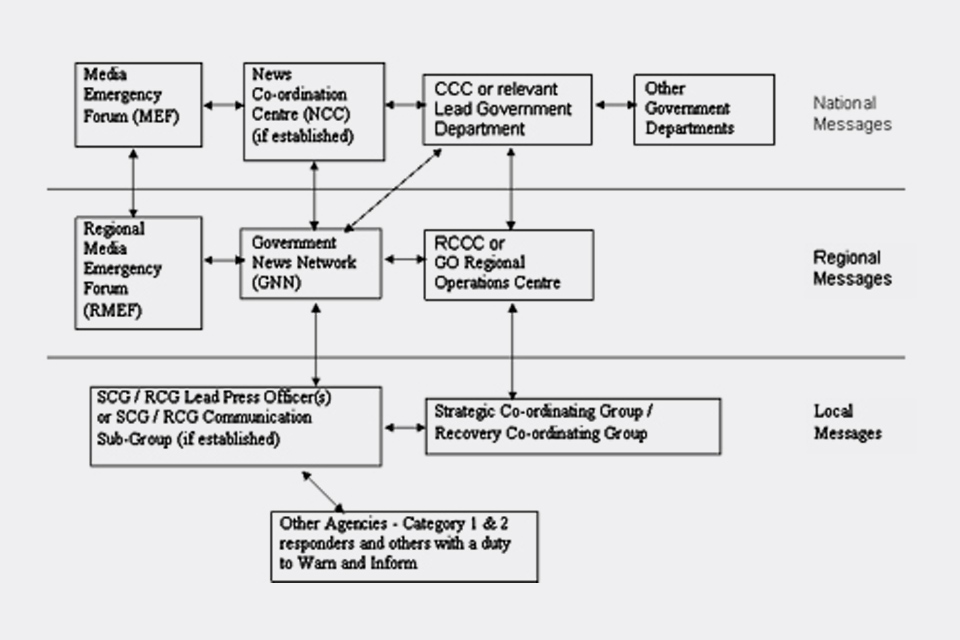
Diagram showing communication flows between National messages, regional messages and local messages.
Devolved Administrations
These issues apply in all areas of the UK.
Wales
In Wales, the Welsh Assembly Government will have a role to play in the co-ordination of the media handling strategy across Wales in close collaboration with the relevant Local Resilience Forum(s).
Scotland
[TBC]
Northern Ireland
[TBC]
Case Studies (Incidents and Exercises)
List of Contacts
The role of Elected Members
Background and Context
Recovery is usually led and co-ordinated by the local authority with support from a number of other partners.
As community representatives and figureheads in their local community, elected members for the affected community have an important role to play in assisting with the recovery process. Although they have a limited role in the operational response phase, the role of the local authority’s elected members is vital to rebuilding, restoring, rehabilitating and reassuring the communities affected and speaking on their behalf.
Roles and Responsibilities
Elected Members
Roles which elected members can play a part in include:
During the planning stages:
Elected members can play a key role both during recovery planning and during the actual recovery phase following an incident. During the planning phase, they can play a role in:
- promoting and encouraging the preparation of community plans
- by using their local knowledge to identify local groups and partners who may be able to play a role in recovery
During the recovery phase of an incident:
Listening to the community
As an elected representative for the area and local figurehead, elected members have a key role as the voice of the community. They are important in:
- being the eyes and ears ‘on the ground’ by providing a focus for and listening to community concerns
- being the voice of the community by gathering the views and concerns of the community and feeding them into the recovery process, through the Recovery Co-ordinating Group’s (RCG) Community Recovery Committee (see diagram below)
- providing support and reassurance to the local community, by listening or visiting those affected and acting as a community champion and supporter
Using local knowledge
As a member of their community, elected members have access to the thoughts, opinions and information relating to their local community. As such, they can play a part in:
- using their local awareness of the thoughts and feelings of the community to identify problems and vulnerabilities the community may have and which may require priority attention and feeding them back to the relevant recovery sub-group
- using their local knowledge to provide information on local resources, skills and personalities to the relevant recovery sub-group. Elected members are also often involved in other aspects of community life such as local community groups which can also be an important source of help and specialist advice. Working closely with community groups, elected members will also be valuable in knowing how and who is active within a community
Providing support to those working on recovery
- providing encouragement and support to recovery teams working within their community
- communicate key messages, from the RCG and its sub-groups, to their communities, disseminating accurate, credible advice and information back to the community and keeping community members involved, including potentially assisting in debrief sessions with the community and managing community expectations in tandem with the local authority
- actively engaging with community members involved in the recovery efforts and in community resilience work more widely
- promoting self-resilience within the community and managing residents’ expectations
Political leadership
- providing a political lead on the way in which decisions are made
- providing strategic leadership. Elected members have a role as committee members within their normal local authority duties and in doing this, give strategic direction and decide policy. They scrutinise decisions of officers and other committees and suggest improvements. As Cabinet Members, elected members will be involved in making key policy decisions and may have to consider recommendations from the RCG on strategic choices. Councillors have a constitutional duty to share corporate responsibility for local authority decision making.
- providing representation to Government for additional resources and financial assistance
- promotion of joint working with Parish, City and District authorities
- liaising with other elected representatives (MPs/AMs/MSPs/MLAs/MEPs/other LA representatives, etc)
- representing their community in the strategic Community Recovery Committee where relevant (see diagram above)
- ensuring recovery issues are mainstreamed into normal functions
- scrutiny – getting buy-in and closure at political level, including sign off for funding
- minimising reputational risk to the authority and defending decisions
- ensuring lessons are identified and addresses, (for example, by updating recovery plans), and shared with others who may find them useful
Media and communications
- maintaining good relationships with the media and public
- supporting the communication effort and assisting with the media in getting messages to the community, for example by giving interviews to the press
- assisting with VIP visits, ensuring that they are sensitive to the needs of the community
- supporting and assisting those affected in how they engage with media interest
Longer-term regeneration
Long after media interest has gone, there will still need to be a long term commitment to ensuring that the recovery of an area continues. In the longer term, elected members may be involved in:
- approving regeneration issues
- consultation on rebuilds or modernisation
- supporting business change in the community
- ensuring community cohesion in the community affected
- considering the need for longer term accommodation
- meeting MPs/AMs/MSPs/MLAs/MEPs to lobby for financial aid
- getting involved in appeal funds and memorials
- repairing and reconstructing the affected community
- ensuring that the lessons identified are applied to emergency/recovery plans and procedures and are shared with others who may find them useful
- by providing input into the humanitarian assistance effort and providing a public interface at Humanitarian Assistance Centres (HACs) (see the Needs of People – non-health topic sheet)
- anniversaries and commemoration
Involvement of elected members within the recovery effort need not just be limited to the elected members whose ward an incident has happened in or whose portfolio area it falls under. As community representatives for their wider area and given the complex, multi-agency nature of recovery and its impacts, all elected members could get involved.
As members of their community, both elected members and local authority staff may themselves be affected by an incident.
Local authorities
The local authority should ensure that its elected members have all the information they need to work effectively during the recovery phase, for example through training and briefing. This will enable them to effectively contribute to incidents and facilitate a return to a new ‘normality’.
Elected members should be involved in planning, training and exercising of plans to ensure that they are familiar with the recovery plans and arrangements and clear about what is expected of them in an emergency.
Training
Training and guidance could be given to elected members to help ensure that they are prepared for assisting in emergencies and in the recovery phase. Such training could focus on developing their awareness to ensure that they understand:
- civil protection legislation, including the Civil Contingencies Act (CCA) and the duties of responders under the CCA
- civil protection and emergency preparedness procedures
- locally identified risks and potential impact to local area / infrastructure
- the remit of elected members during the recovery phase and what is expected of them, ensuring that they are aware of what their role and responsibilities will be in an emergency, including their role within the Community Recovery Committee or RCG. This may also include clarifying what they might expect if they are to ‘approve’ the recovery strategy. Note that the normal political processes and structures will still apply in the recovery phase. Some Members may sit on both the Community Recovery Committee and their normal committees
- the difference between the response phase and recovery phase of an incident
- the role of other agencies within the recovery phase of an incident
- media awareness
- understanding of the central government recovery funding arrangements and principles
- how elected members should engage with other professionals, the media and the public
- the involvement of elected members in the delivery of key messages to the public, including how to communicate key messages to their communities
- how to give information, advice and guidance to the Community Recovery Committee and other agencies
- how elected members can scrutinise the recovery process
Elected members should be involved in exercises of recovery plans.
By training Elected Members in these areas in the planning stages, they will be prepared and clear of their responsibilities and role should an incident happen.
There may also be a benefit in training other agencies and organisations on the roles and responsibilities of elected members so that they are aware of their function within an emergency.
Elected members have a role as Cabinet members within their normal local authority duties and in doing this, give strategic direction and decide policy. They scrutinise decisions of officers and other committees and suggest improvements. They will ultimately scrutinise actions affecting the functions of Councils at all levels (including County/Unitary/District/City/Parish/Town/Community) so they will need to be kept well informed with accurate and up to date information to enable them to make credible and well informed judgements.
The Emergency Planning College provides training on crisis management and emergency planning, including an Introduction to Civil Protection and Recovering from Emergencies courses. It runs on-demand courses aimed at elected members which are delivered locally as and when requested by local authorities.
Briefing
There is a need to engage with elected members regularly throughout an emergency, from the planning phase, to the response phase and throughout the recovery phase. Elected members should be briefed thoroughly and regularly on the activities of the agencies involved during the recovery process.
Regular briefing is also important in ensuring that elected members sustain their community involvement and are able to communicate effectively and appropriately with agencies, the media and the public.
Elected members also need to be aware of other issues that may arise, and for which the local authority may be responsible or impacted, including:
- civil litigation
- criminal proceedings
- public inquiries
- impacts on council budgets (see the Financial impact on local authorities topic sheet) and loss of income for the council
- impacts on local authority performance targets (see the Impact on local authority performance targets topic sheet)
- insurance
- claims to the government
- long term effects on the community including long-term health and psychosocial effects
- lmpact on the local economy and business regeneration
Devolved Administrations
In Northern Ireland, different central and local government structures mean that district councils (the only level of council in Northern Ireland) have fewer service delivery functions than their counterparts in Great Britain, and functions such as social care are delivered by central government departments and their agencies and NDPBs. Northern Ireland civil contingencies legislation, the roles and responsibilities of individual organisations in relation to recovery, and the arrangements for co-ordinating the multi-agency recovery process differ from those in Great Britain. Nevertheless, the district councils play an important part in facilitating recovery at local level and the principles set out in this Topic Sheet offer a helpful indicator of the role which elected members of district councils can play as interfaces between council recovery arrangements and the community. Members of the Northern Ireland Assembly and Executive Ministers also have a very direct involvement with their communities and can similarly link with other service delivery organisations, within local structures and recovery arrangements.
Case studies (incidents and exercises)
Other documents
List of contacts
- Communities and Local Government
- Local Government Association
- Society of Local Government Chief Executives (Solace)
VIP visits and involvement
Background and Context
Following any emergency, it is likely there will be a desire for VIPs to visit the scene and to provide support to the affected community. Such visits may include members of the Royal Family, Ministers and MPs, faith leaders, other dignitaries or celebrities. Visits often take place during and immediately after the response phase, but may also be followed up in the recovery phase to provide continued support to affected communities and to observe progress on recovery.
The benefits of such visits include raising and maintaining awareness of the emergency, reinforcing messages of thanks, providing visible support to the community, helping to ‘fast-track’ some aspects of recovery, and giving positive media messages around the return to ‘normality’.
Key to the success of any such visit is community engagement with the planning of the visit and the decisions around the programme. For example, Faith Leaders may provide significant spiritual support to affected communities and such visits can also provide an important focus for reconciliation and developing community cohesion. However, it is important to assess the impact of any visit on the community to ensure it does add value.
Therefore, early and ongoing communication between local and regional partners, the affected community and the potential visitor is vital to ensure the benefits are maximised. Elected members can play a key role in this decision making process, reflecting the needs of their communities.
Policy and guidance
England
There is limited guidance available on the nature of visits and who are the most appropriate individuals to engage in the longer term recovery. Some guidance on the role of the Government Office in organising visits is described in Emergency Response and Recovery.
The choice of visitor can be by local determination, although Ministers and senior officials may also approach the communities after an emergency. Government Offices can provide advice and, importantly, a link to government departments to ensure assistance in development of programmes for visits and assistance in maximising their benefit.
Wales
The Welsh Assembly Government will need to be involved in any visits to Wales by the Royal family, UK Ministers or foreign dignitaries.
Scotland
[TBC]
Northern Ireland
[TBC]
Roles and Responsibilities
Local and Regional
Local partners, including the voluntary and faith communities, will wish to consider the appropriate visitors/support which may best focus the needs of the community and raise and maintain the necessary profile of the aftermath of the emergency. As the recovery proceeds, then the focus of such visits may change, from sympathy and gratitude to the responders, to more focus on the recovery and return to ‘normality’ for the community.
Both the community and the VIP will wish to maximise the benefit of any visit and ensure that a visit is neither divisive not overly onerous on the community. In considering any visit, especially where there may be an effect on community cohesion, it is important to assess the impact of the visit and to advise whether or not it would add value.
Lead Government Department
Where visits are by Ministers, the Lead Government Department would be responsible for arranging the visit, with local organisation done through the Government Office. Press and media liaison is organised via the COI News Distribution Service.
Royal visits are co-ordinated by the Royal Household through the Lord Lieutenant’s Office (there is one per LRF area). Details of the role and function of the Lord Lieutenant.
For Royal visits, press and media liaison is dealt with by the relevant Royal Household.
In some circumstances, it is possible that a foreign VIP (ie. Head of State / Prime Minister / Foreign Minister) may wish to visit the UK after an emergency, particularly if foreign nationals were affected. In this instance, the Visit Team in the Protocol Directorate of the Foreign and Commonwealth Office (FCO) would be able to offer any logistical assistance required to the VIP. This could involve managing the visit from arrival to departure, any hospitality and transport. The desk in the FCO would set up any necessary calls with officials and would expect to be in contact with the Foreign Mission in London about arrangements.
Other Government Involvement
For Ministerial visits, organisation of the visit on the ground will be undertaken by the Government Office in partnership with the Minister’s Private Office, and with local organisations, to determine an appropriate programme for the visit.
Devolved Administrations
Any visit by a UK Minister to a devolved region is carried out in consultation with the Devolved Administration concerned.
Wales
Visits of UK Ministers and members of the Royal family to Wales need to be arranged in conjunction with the Public Administration Unit and Press Office of the Welsh Assembly Government. Visits by Welsh Ministers will be arranged between policy Departments, Ministerial Offices and the relevant responder agencies.
Scotland
Royal visits are co-ordinated by the Royal Household through the Lord Lieutenant’s Office
For Ministerial visits, organisation is undertaken by the Scottish Executive
Northern Ireland
[TBC]
Funding
Costs of Ministerial and associated visits are covered by the relevant Government Department.
Security costs for Ministerial and Royal visits fall to the police.
For visits by foreign VIPs, the Protocol Directorate (FCO) would probably meet the costs for a Guest of Government status, under special circumstances and as a one off, but this agreement would depend on the VIP’s status and other criteria at the time.
Devolved Administrations
Wales
Security costs for VIP visits to Wales fall to the Police.
Scotland
Scotland – funding is the same as England.
Northern Ireland
[TBC]
Case Studies (Incidents and Exercises)
Other Documents
List of Contacts
Impact on Local Authority Performance Targets
Background and Context
Currently, local authorities are set targets by several Government Departments in respect of a range of their activities. Targets can include a requirement that a certain minimum standard is achieved, eg at least 20% of all pupils to obtain 5 or more GCSEs (known as ‘floor targets’) or they may be aspirational, eg. 65% of pupils to obtain 5 or more GCSEs in 2008, rising to 68% in 2009, etc.
Some incidents, such as the Carlisle floods and the explosion at the Buncefield oil depot, have shown that, due to resource pressures and other consequences, local authorities have been unable to meet certain performance targets.
Local authorities who administer Housing and Council Tax Benefit report quarterly against a number of performance measures. When an incident affects a local authority’s ability to meet certain targets, all circumstances will be taken into consideration when monitoring performance, carrying out inspections or making judgements on performance in the wider context of the Comprehensive Performance Assessment.
Policy and Guidance
England
A new performance framework for local authorities and their partners in England is being introduced in 2008-09. The framework has been designed to:
- strengthen accountability to citizens and communities
- give greater responsibility to local authorities and their partners for securing improvements in services
- provide a better balance between national and local priorities
- improve arrangements for external assessment and inspection
Under the new framework, there will be a revised Local Area Agreement (LAA) process through which central Government and Local Strategic Partnerships (LSPs) will agree and manage a limited number of performance targets for each local area.
The focus will be on the 150 single tier (unitary) authorities and county councils. District authorities will report on progress against their activities to their county council rather than direct to central Government or the relevant Government Office for the Region. Where appropriate, county councils will include this performance information in their annual performance report to their Government Office (eg when there is an improvement target in a LAA that relate to a service for which a district authority has responsibility, eg housing).
Under the new framework, the number of improvement targets for each LAA will be limited to a maximum of 35 plus 18 statutory DCSF targets, creating more space for local flexibility. Targets will be negotiated between each LAA and their Government Office. LAAs will report to GOs annually on progress against their targets.
Guidance on Local Area Agreements is currently being drafted by Communities and Local Government and should be available in the Autumn.
Circumstances, which mean that local authorities are unable to meet certain targets, will be considered on a case by case basis.
Wales
In Wales, performance management arrangements do not currently include setting national targets that local authorities must attain.
Scotland
The Scottish Government are in the process of developing performance monitoring arrangements with local authorities.
Northern Ireland
Due to the comparatively limited role of local authorities in Northern Ireland, there are fewer government-set targets to meet. The LAA process through LSPs is currently being assessed for use within Northern Ireland, though its implementation might be not be introduced until the Review of Public Administration is carried out.
Roles and Responsibilities
Local and Regional
National improvement targets will be negotiated as part of the Local Area Agreements between Government Offices and Local Strategic Partnerships. All such targets will have been agreed with the relevant Government Department beforehand.
Lead Government Department
No single Government department is in the lead. Local authorities deliver services that come within the remit of several government departments, eg. schools (DCSF), waste (Defra) and housing (CLG). The Government Office will be the local authority / local strategic partnership’s first port of call.
Devolved Administrations
Wales
In Wales, local authorities are responsible for setting and reporting on their own performance targets, under the Wales Programme for Improvement.
Scotland
The Scottish Government are currently in the process of developing performance monitoring arrangements with local authorities.
Northern Ireland
Local Authorities in Northern Ireland, having liaised with the Government Office responsible (i.e. Food Standards Agency), might look at reallocation of resources and the use of external agency staff to cover important areas of target driven work.
Case Studies (Incidents and Exercises)
List of Contacts
Inquiries
Background
Statutory and non-statutory public inquiries may be set up for a wide variety of reasons to deal with important matters, including planning applications and new road schemes. However, those that are relevant to recovery will be public inquiries set up to inquire into the causes of a disaster of some kind. Previously, the principle piece of legislation was the Tribunals of Inquiry (Evidence) Act 1921 which was repealed and replaced by the Inquiries Act 2005 although inquiries were also set up under a range of other Acts.
The 1921 Tribunals of Inquiry Act was intended to be used for the most serious matters of “urgent public importance” and provides for a tribunal of inquiry that looks very much like a court. The first inquiry under the Act which dealt with a disaster was the inquiry into the loss of HM Submarine Thetis on its maiden voyage in June 1939 which involved the deaths of 99 men. The next disaster to be inquired into was the disaster at Aberfan in 1966, followed by the original inquiry into the events of Bloody Sunday in 1972. A collection of more modern inquiry powers were developed over the years, which covered some particular subject areas such as policing and health, but not others such as prisons. Increasingly, governments have started to set up ad-hoc, non-statutory inquiries, often because there is no appropriate legislation for statutory ones.
The 2005 Act creates a comprehensive new statutory framework for inquiries set up by ministers to look into matters of public concern. It replaces over 30 different pieces of legislation on inquiries, consolidating much of the current legislation and codifying past practice for inquiries. It covers the setting up of inquiries, the appointment of people to conduct them, their procedures and their powers, and the submission and publication of reports.
The Act is not designed for planning inquiries, or any other inquiries that take place as part of an administrative, decision-making process. Nor is it designed to cover inquiries commissioned by anyone other than government Ministers - for example, inquiries set up by the Health and Safety Commission. These types of inquiry are designed for a specialist purpose, and have their own legislation.
The 2005 Act will only be used for inquiries that need to have statutory powers. There will still be a place for non-statutory inquiries. There will also be some subject areas, such as financial services, where it is appropriate to keep a specialised framework in place.
Inquiries do not determine civil or criminal liability. They are not a substitute for court proceedings, and they don’t punish people or award compensation. They are a tool for establishing facts and preventing a problem from recurring.
On the face of the 2005 Act, there is a new requirement on an inquiry chairman to have regard to the need to control costs. Sections on payment of inquiry and witness expenses provide the Minister with a degree of budgetary control, while ensuring that the inquiry has adequate funds. Proposed procedure rules should strengthen a chairman’s hand in controlling costs.
Under the 2005 Act, inquiries will be able to compel any information that could be compelled by a court in normal civil proceedings. Failure to co-operate will be a summary offence, and inquiry chairmen will also have the option of asking the High Court to enforce any orders that they make. During the last few years, there have been a number of inquiries set up to investigate the circumstances surrounding disasters:
- 1996 Public Inquiry into the shootings at Dunblane Primary School - set up under the 1921 Act by the Scottish Office and chaired by Lord Cullen
- 1997 Southall Rail Accident Inquiry set up under s14(2)(b) of the Health and Safety at Work etc Act 1974 by the Health and Safety Commission and chaired by Professor Uff QC
- 1997 BSE Inquiry set up on a non-statutory basis by the Ministry of Agriculture, Fisheries and Food and chaired by Lord Phillips
- 1998 Bloody Sunday Inquiry set up under the 1921 Act by the Northern Ireland Office and chaired by Lord Savile - ongoing
- 1999 Thames River Safety Inquiry set up on a non-statutory basis and interim to the 2000 Marchioness Inquiry set up under the Merchant Shipping Act 1995 s268, also 2000 non-statutory inquiry into identification issues - all chaired by Lord Justice Clarke
- 1999 Ladbroke Grove Inquiry set up under 1974 Act (see Southall above) by Health and Safety Commission and chaired by Lord Cullen
- 2000 Shipman Inquiry set up under the 1921 Act by Department of Health and chaired by Dame Janet Smith
- Coroner’s Inquests into the London Bombings of the 7 July 2005.
No inquiries into a disaster have been set up under the 2005 Act, which came into force on 7 June 2005 throughout the UK. Earlier inquiries have been converted to inquiries under the 2005 Act in respect of the deaths of Billy Wright and Robert Hamill in Northern Ireland although these have been the subject of judicial review proceedings, challenging the decision to so convert.
Section 19 of the 2005 Act gives the minister power to make a restriction order prohibiting disclosure of evidence in the public interest. The restriction order might apply indefinitely and would not be restricted to matters of national security.
UK policy and guidance
Public inquiries are governed by the Inquiries Act 2005 and a wide variety of other legislation, including the Health and Safety at Work etc Act 1974, Merchant Shipping Act 1995, Railways Act 2005, and the National Health Service Act 1977. But public inquiries may also be established on a non-statutory basis. This was the case with the BSE Inquiry and the Stephen Lawrence Inquiry. An information sheet on the Inquiries Act 2005 was issued by the then Department for Constitutional Affairs (DCA) on 7 June 2005.
No guidance has been issued to local authorities on the handling of public inquiries. It is expected that all persons called to give evidence to a public inquiry will fully co-operate with that inquiry. The inquiry team may of course offer advice to those appearing as witnesses or otherwise involved and ensure that such persons are aware of the terms of reference and what may be expected of them. In cases of doubt, the persons concerned should clarify their position. Under no circumstances should a person be expected to incriminate themselves when answering a question. Public inquiries do not determine questions of criminal or civil liability.
Devolved administrations
The Inquiries Act applies throughout the United Kingdom. Other legislation may vary. Devolved administrations have powers to set up non-statutory inquiries.
Roles and responsibilities
England
A decision on the form of an Inquiry is taken by ministers at the time depending on the nature and circumstances of the event, except where this has been devolved to an independent body such as the Health and Safety Commission. The default position is to establish an inquiry under the Inquiries Act 2005 - however, the minister may decide for whatever reason to use other legislation or perhaps proceed on a non-statutory basis. The terms of reference will normally be determined wholly by the minister in discussion with officials and, as necessary with the benefit of the knowledge of technical experts. Other legislation which might be considered is:
- in cases where there has been fatalities in England and Wales under section 17A of the Coroners Act 1988 exceptional reason to the contrary”, and may discharge any jury. He must then sign and send to the registrar of deaths a certificate stating the registration particulars, so far as by then ascertained. Once the findings of the public inquiry are published, the Lord Chancellor must send the coroner a copy. The coroner may only resume the inquest after 28 days from publication of the findings or (if the Lord Chancellor directs) from the end of the inquiry, and then only if, in his opinion, there is exceptional reason to do so. This procedure was followed in the Ladbroke Grove Rail disaster, as well as the Shipman Inquiry (twice), the Gaul inquiry (twice) and the Hutton Inquiry. There are separate arrangements in Scotland and Northern Ireland (see below)
- the Health and Safety at Work etc Act 1974 where under section 14 of this Act, the Health and Safety Commission has powers to direct investigations and inquiries into …”any accident, occurrence, situation or other whatsoever which the Commission thinks it necessary or expedient to investigate…”
- the Secretary of State for Health may cause a local inquiry to be held under section 318 of The Public Health Act 1936 in any case where he deems it advisable that one should be held in relation to any matter concerning the public health in any place
- the Secretary of State for Environment or for Wales can cause a local Inquiry to be held under section 96 of the Control of Pollution Act 1974 with a view to preventing or dealing with pollution or under section 70 of the Public Health (Control of Disease) Act 1984 in relation to any matter concerning the public health
Many inquiries will be held close to the events which have occasioned its establishment. For example, the Shipman Inquiry was held at Manchester Town Hall; the Bristol Royal Infirmary Inquiry took place in Bristol. In such circumstances, local authorities are expected to co-operate fully with the inquiry team in finding suitable facilities if requested to do so. In particular, the local authority should be willing to find suitable accommodation and second administration staff as required.
The Inquiry’s own responsibility in this area will be to ensure that its needs are fully understood by those it has requested to provide or facilitate the provision of resources.
Wales
As outlined above.
Scotland
In Scotland, Ministers can set up ad-hoc inquiries as well as inquiries under the 2005 Act or under the various pieces of health and safety legislation (Lord Fraser’s inquiry into the building of the Scottish Parliament building was an ad-hoc inquiry).
Northern Ireland
In cases where there have been fatalities in Northern Ireland (NI), these would be governed by the Coroners Act (NI) 1959 and the Coroners (Practice and Procedure) Rules (NI) 1963. A decision on the holding of an inquest in NI would not be considered until after the Coroners investigation has been completed. Section 11 of the Rules gives Coroners the general power to adjourn an inquest either before commencement, at commencement, or during the hearing, to a fixed date or no set date (sine die), and also allows for the decision not to resume an adjourned inquest.
Whilst there is no compulsion on Northern Ireland (NI) Coroners to adjourn inquests in such circumstances as outlined above (ie. when a judicial public inquiry is to be held), the general practice followed is compatible. In general terms, the NI Coroners investigation into a death will continue in parallel with any other investigation or inquiry into the circumstances of the death. However, at the point when a decision regarding the holding of an inquest would naturally occur, the Coroner will take note of the position with the other investigation or inquiry, and will suspend his / her decision until after the result of this is known.
Funding
The costs of the inquiry will be met by the relevant government department or from the budget of the independent body unless, although this seems highly unlikely, an inquiry into a disaster has been established by local or regional government, rather than central government.
Case studies (incidents and exercises)
There have been no cases where the Inquiries Act 2005 was used. All public inquiries relating to disasters were either under the 1921 Act, non-statutory or under other legislation.
Contacts
More information about public inquiries can be found on the Ministry of Justice website.
Investigations and prosecutions
Background
The cause of an emergency may be immediately apparent, but should not be presumed until investigations (and possibly prosecutions) are completed. Whilst the rescue of survivors must take precedence, once the rescue phase is complete and the scene has been declared safe, it must be protected from interference or unnecessary movement. The site must be treated as a crime scene, and its protection is vital to preserve evidence. However, a key consideration will be to restore services at the earliest opportunity.
The purpose of any prosecution is to prove beyond reasonable doubt that an offence has been committed, rather than establishing the circumstances of an accident or incident. Witnesses are essential to investigations and prosecution and fall into the following categories:
- survivors
- eye witnesses
- emergency service personnel
- technical witnesses, and
- identification witnesses.
Policy and guidance
England and Wales
All policing will be conducted within the bounds of the prescribed legal parameters. These parameters are based in statutes such as:
- Pubic Health and Safety Act 1997
- Transport and Works Act 1992
- Offences against the Person Act 1861
- Police and Criminal Evidence Act 1994
- Data Protection Act 1988
- Control of Substances Hazardous to Health Regulations 1994
- Health and Safety at Work Act 1974
- Article 85 on the Air Investigation Order 2000
- Common Law
- International Law
- ECHR HR 1998
- Manslaughter and Corporate Homicide Act 2007
An emergency involving work-related deaths (eg. train crash, chemical site incidents) will fall under the protocol agreed between the Health and Safety Executive, the Police Service and the Crown Prosecution Service in April 1988, which sets out the principles for effective liaison between the three agencies.
Scotland
Scotland – Crown Office and Procurator Fiscal Service (CPFS): Scotland’s sole prosecution service
Northern Ireland
[TBC]
Roles and responsibilities
One of the primary police responsibilities in response to an emergency is that of investigation, in conjunction with other investigative bodies if applicable. The role of the police in an investigation is to establish whether there is sufficient evidence to justify criminal proceedings. Where the emergency results in injury or death, the overall Incident Commander will immediately appoint a Senior Investigative Officer (SIO) to initiate a major crime inquiry. The SIO will work in conjunction with the Incident Officer, Senior Identification Manager (SIM) and any other legally-appointed investigative agency, assisting in the collation of evidence for the purposes of the investigation.
The Crown Prosecution Service (CPS) is a non-ministerial department of the government, responsible for the prosecutions of people charged with criminal offences in England and Wales. The CPS is headed by the Director of Public Prosecutions (DPP), answering to the Attorney General. The CPS is responsible for criminal cases beyond investigation (which is the role of the police). This involves advising the police on what charges to bring, authorising all but a very few simple charges, and preparing and presenting cases at Magistrates and Crown Courts.
The Department for Transport has three dedicated accident investigation branches, whose sole objectives are to determine the circumstances and causes of a transport accident and, where necessary, issue safety recommendations. These branches are the Rail Accident Investigation Branch (RAIB), the Marine Accident Investigation Branch (MAIB) and the Air Accident Investigation Branch (AAIB). They all form part of the DFT but are functionally independent.
There will also be MOD Boards of Inquiry following any serious military incident.
Any death in prison is investigated by the Office of the Probation and Prison Ombudsman.
Devolved administrations
Wales
As Above
Scotland
[TBC]
Northern Ireland
[TBC]
Funding
England
- Funding for police investigations – Home Office
- Funding for transport investigations – Department for Transport
Wales
Rail investigations are non-devolved. Road investigations are done by the police, funded by the Home Office.
Scotland
[TBC]
Northern Ireland
[TBC]
Case studies (incidents and exercises)
Other documents
Railways
- Railway and Transport Safety Act 2003
- The Railways (accidents, investigations and reporting regulations) 2005
- European Railway Safety Directive 2004/49/EC
Marine
- The Merchant Shipping Accidents Reporting and Investigation Regulations 2005
- 2005 Regs Regulatory Impact Assessment
- Merchant Shipping Act 1995 extracts
Aviation
- Civil Aviation (Investigation of Air Accidents) Regs 1996
- Civil Aviation Acts 1949, 1968, 1982, 1989
- Convention on International Civil Aviation (The ‘Chicago’ Convention)
Contacts
- Rail Accident Investigation Branch (RAIB)
- Marine Accident Investigation Branch (MAIB)
- Air Accident Investigation Branch (AAIB)
Coroner’s inquests
Background
A coroner is an independent judicial officer who in a specific geographical territory or area (“coroner’s district”) is exclusively responsible for the conduct of inquests (and the ordering of any post-mortem examination) in respect of those bodies lying in the district where he is informed of the death and has reasonable cause to suspect that the death was violent or unnatural or sudden of unknown cause … whether or not the cause of death arose in the district or elsewhere. Thus a coroner’s involvement in any fatal incident depends upon it being reported that at least one body is lying in the coroner’s district.
In an emergency, such as the Indian Ocean Tsunami, where a UK citizen dies abroad, the death will be reported to the coroner of the district in which the body has been initially repatriated (ie. even if the deaths occurred elsewhere, eg. Thailand). This coroner shall be responsible for the body, although the coroner has no jurisdiction until the body is physically brought into his district.
In cases, such as in 7th July bombings, where the police are carrying out investigations, after the post-mortem examinations and the identification processes are satisfactorily completed, the inquests will be “opened” and then adjourned until the investigations are complete or a criminal trial is concluded. The coroner may also order additional forensic post-mortem examinations.
Some inquests can be resolved very quickly, within a matter of weeks or certainly months, but others may take many months or even years if the investigation is prolonged to assist the police in the criminal investigation process.
Policy and guidance
England and Wales
Coroners’ inquests and post-mortem examinations are governed by primary and secondary legislation. The most important of these are the Coroners Act 1988 and the Coroners Rules 1984. Local authorities appoint coroners (although coroners are not employees, but office holders under the Crown), and guidance has been issued to local authorities on this by the Home Office in Home Office Circular No 9 of 1996 (until May 2005, the Home Office had policy responsibility for coroners. This has now transferred to the Ministry of Justice).
No guidance has been issued to local authorities on the handling of inquests and post-mortem examinations. The coroner(s) concerned has/have sole and exclusive responsibility as to how they should interpret and carry out their judicial responsibilities and conduct any inquests; those aggrieved by any decision may seek a judicial review. Coroners will take account of the relevant textbooks including Jervis on Coroners 12th Edition published by Sweet and Maxwell of which chapter 17 deals with Major Disasters. An alternative textbook is Dorries on Coroners Courts, published by Oxford University Press, of which chapter 11 deals with Disasters. Neither of these textbooks is aimed at local authorities. Coroners may also refer to the Coroners’ Society of England and Wales.
Guidance of a general nature about coroners and inquests is contained on the Ministry of Justice website.
Scotland
See: Inquiries into deaths in Scotland
Northern Ireland
Criminal Justice is not yet a devolved function in Northern Ireland. Consequently, the organisations involved in the criminal justice system in Northern Ireland are ultimately responsible to Whitehall Ministers. Northern Ireland has its own Coroners Service that is administered by the Northern Ireland Court Service.
The role and responsibilities of the Coroner in Northern Ireland are determined by the Coroners Act (NI) 1959 and the Coroners Practice and Procedures Rules (NI) 1963.
The Coroners Service is headed by a High Court Judge. There is one Senior Coroner and two other full-time Coroners. These Coroners cover the whole of Northern Ireland there are no Coroners districts as in England and Wales.
Further information on the Coroners Service for Northern Ireland, and literature which it produces explaining its role, can be found at http://www.coronersni.gov.uk.
Roles and responsibilities
Local and regional
Where appropriate, the role of the coroner includes:
- ordering post-mortem examinations on those bodies lying within his/her district
- establishing the identity of the deceased person(s)
- conducting inquests (unless deaths are shown to be natural, when an inquest will not be required), and
- releasing the bodies to the family/families for funeral purposes as soon as possible
Coroners are not responsible for declaring the cause of death – this will be found from evidence that is produced to them, either from a pathologist who has made a Post Mortem examination, or from another registered medical practitioner who has been in attendance on the deceased during their last illness and can give a professional opinion as to how (medically) the death came about.
The coroner does not make recommendations, however, under the rules of procedure, the coroner may, at the conclusion of an inquest, announce that he is writing to the appropriate authority to draw attention to matters that have become apparent in the course of evidence.
A coroner may summon as a witness to give evidence at an inquest, anyone who is in England and Wales. Any witness is required to answer truthfully the relevant questions put to them, although the coroner also has a duty to protect witnesses against self-incrimination.
The coroner will not, personally, normally speak or otherwise deal with the media but, instead, will rely upon the police or other dedicated media spokesperson. For more information about working with the media, see the Working with the media section of this guide.
In the London region, the Coroner’s Support Service can assist people through the system.
The coroner’s local authority has the responsibility for funding the coroner’s service including all matters relating to inquests and post-mortem examinations. It is not up to the local authorities to conduct inquests but to support and resource the coroner. Some coroners’ districts will consist of a number of local authority areas, particularly those within Greater London and the metropolitan counties.
For example, the tsunami coroner was the coroner covering Heathrow, as the UK bodies returned there. Hillingdon is the local authority covering Heathrow but the coroner’s lead authority is the London Borough of Hammersmith and Fulham, which meets all the financial costs of the coroner’s service within West London. A proportion of these costs are recovered from the other local authorities within West London, including Hillingdon.
The 7th July coroners are the Inner North and Inner West London coroners, whose lead authorities are Camden and Westminster respectively. These councils will recover a proportion of the costs from the other local authorities making up those two districts.
There is no regional or central government responsibility for inquests.
Lead Government Department
The Ministry of Justice is now responsible for the policy in relation to coroners and inquests in respect of England and Wales.
Devolved administrations
Wales
The same arrangements as set out above apply in Wales – inquest policy has not been devolved.
Scotland
See: Inquiries into deaths in Scotland
Northern Ireland
Northern Ireland Coroners inquire into deaths reported to them that appear to be:
- unexpected or unexplained
- as a result of violence
- as a result of an accident
- as a result of negligence
- from any cause other than natural illness or disease, or
- in circumstances that may require investigation
The Coroner will endeavour to establish the cause of death and will make whatever enquiries that are necessary to do this by ordering a post mortem examination, obtaining witness statements and medical records or holding an inquest.
The role of the Coroner in Northern Ireland is similar to that of the Coroner in England and Wales, but there are differences. In particular, the Northern Ireland Coroners have no authority to investigate deaths which occur outside Northern Ireland. This means that they cannot investigate deaths which occur abroad due to an emergency. In cases where a UK inquest is considered necessary, a body would be repatriated through GB or the Republic of Ireland and an inquest would be held by the coroner responsible for the port of entry.
The NI Court Service works closely with the Northern Ireland Office to ensure that the NI Criminal Justice system works effectively. Pathology services to Coroners are provided by the State Pathologist’s Department, which is an arms-length body of the Northern Ireland Office.
Funding
Local authorities pay the salaries of coroners. The rates are agreed by the Joint Negotiating Committee for Coroners, whose membership consists of the Coroners’ Society of England and Wales and the Local Government Association as deemed employers.
All costs relating to inquests and post-mortem examinations are met by local authorities.
Fees for post-mortem examinations and witness and jury expenses in relating to inquests are set by the Ministry of Justice, in accordance with section 24(1) of the Coroners Act 1988. These are promulgated to local authorities via the Local Government Association, most recently in April 2007. Local authorities themselves fix other fees under section 24(2) of the 1988 Coroners Act.
Devolved administrations
Wales
The Welsh Assembly Government is responsible for the funding of local authorities in Wales.
Scotland
See: Inquiries into deaths in Scotland
Northern Ireland
Northern Ireland Court Service fund coroners in Northern Ireland, but the ultimate financial responsibility rest with the Ministry of Justice.
Funding for the pathology services in Northern Ireland is the responsibility of the Northern Ireland Office.
Case studies (incidents and exercises)
Other documents
The following sources provide more information on coroners’ inquests:
- Coroners’ Society website
- Kings College, London website – editor of Jervis on Coroners provides an update
Inquiries into deaths in Scotland
Background
There is no coroner in Scotland. The Crown Office and Procurator Fiscal Service is the prosecution service in Scotland and inquires into all sudden, suspicious, unexplained or accidental deaths.
The Procurator Fiscal investigates certain categories of deaths. The aim on any investigation is to find out whether any criminal act has caused or contributed to the death, or to discover whether the death has arisen from hazardous circumstances where action may prevent future deaths or injuries. Usually, sudden deaths come to the attention of the Procurator Fiscal through a report from the police, a doctor or the local Registrar of Births, Deaths and Marriages.
Policy and guidance
Fatal Accident Inquiries are held under the Fatal Accidents and Sudden Deaths Inquiry (Scotland) Act 1976.
The Inquiries Act 2005 and the Health and Safety at Work etc Act 1974 also apply in Scotland. For further details of these, see the Inquiries section of this guide.
Roles and responsibilities
Local and regional
When there is an emergency, the Procurator Fiscal is advised immediately and attends the scene. During the investigation, the Procurator Fiscal works with the police or other relevant bodies to ensure that all relevant information is collated. Usually, the police and/or other relevant reporting agencies submit a report to the Procurator Fiscal for consideration. Once the Procurator Fiscal has all the relevant information, he or she will consider what, if any, action is appropriate. The decision in relation to the nature of proceedings, which may follow in connection with a death, cannot be determined until the investigation by the Procurator Fiscal has been concluded.
The investigation is designed to determine whether there are circumstances to confirm that the death appears to have been caused as a result of a criminal act or omission and, if not, whether the death has occurred in circumstances where a discretionary Fatal Accident Inquiry is appropriate. An inquiry may be held in other cases of sudden, suspicious or unexplained death, or death in circumstances that give rise to serious public concern. Decisions on whether these discretionary inquiries are held are made by the Lord Advocate.
A Fatal Accident Inquiry is essentially a fact-finding exercise carried out in the public interest. The rules of evidence and the standard of proof are as for civil cases in Scotland. The purpose is to determine where and when the death took place, the cause of the death, reasonable precautions whereby the death might have been avoided, the defects, if any, in any system of working which contributed to the death or any accident resulting in the death, and any other relevant facts relevant to the circumstances of the death.
The purpose is not to apportion blame for the death in either the civil or criminal sense. A Fatal Accident Inquiry may be held in addition to any criminal or civil proceedings.
A mandatory Fatal Accident Inquiry will occur in relation to a death in custody or as a result of an accident in the course of employment.
Lead Government Department
The death will be reported to the Crown Office for the instruction of Crown Counsel once the investigation has been concluded.
Crown Counsel will instruct a prosecution where there is sufficient evidence of criminality and it is in the public interest to do so. A Fatal Accident Inquiry may follow upon a prosecution where the prosecution has not sufficiently dealt with relevant issues in connection with the death.
If criminal proceedings are not being initiated, a discretionary Fatal Accident Inquiry may be instructed by Crown Counsel if the circumstances give rise to serious public concern and it is in the public interest to do so.
Ministers in Scotland, England, Wales and Northern Ireland may set up inquiries under the Inquiries Act 2005. However, Ministers in the devolved administrations cannot set up inquiries where the terms of reference would require the inquiry to determine any fact or make any recommendation that is not wholly or primarily concerned with a matter which is within their competence in accordance with the devolution settlement. A UK Minister may not set up an inquiry where the terms of reference would require the inquiry to determine any fact or make any recommendation which is wholly or primarily concerned with a devolved matter without first consulting the devolved administration. It is also possible for a joint inquiry to be set up by two administrations.
Case studies (incidents and exercises)
- None received to date
Other documents
- The Health and Safety Executive, COPFS, ACPOS and the British Transport Police have published a protocol on work-related deaths
- Consultation on Inquiries (Scotland) Rules
Contacts
[TBC]
Recovery evaluation and lessons identified processes
Background
After an emergency, it is very important that thorough debriefs and reports are carried out to capture issues identified, recommendations to be implemented, and planning assumptions to be reviewed. However, the processes required in order to share the issues identified are not always clear. Many responders look to the agencies affected by an emergency to provide them with information so they too can be prepared for a similar event.
The recovery phase of an emergency has additional complications in that the time line is longer and it potentially involves more stakeholders than the response phase. Typically, it has peaks of activity, such as around the time of an anniversary, as well as routine ongoing work to address the physical and psychological effects of the emergency.
For most emergencies, it is appropriate to carry out a number of debriefs at different stages in the recovery, when certain “recovery milestones” are achieved or a certain period of time has elapsed. It may be a number of months since the emergency until the first recovery debrief can take place, but there should be a continual process for debriefs throughout the recovery phase.
In widespread emergencies, involving the regional or national tier, debriefing at local level may feed into a regional or national level document. In these cases, the process and format may be steered by the regional or national tier in order to produce a consistent and comprehensive debrief.
As debriefing moves from response to recovery, it is increasingly important that the community (including businesses) is involved at all stages. Elected members can play a key role in this, chairing public debrief meetings and business debrief meetings. They can also be useful for door-knocking rounds, bringing back issues that the community has identified, and providing a trusted point of contact for those with concerns.
The contents of debrief documents may be used as evidence in Public inquiries (see Inquiries section for more information).
Policy and guidance
England
General
Both the statutory guidance Emergency Preparedness and the non-statuary guidance Emergency Response and Recovery refer to the need for debriefing following an emergency.
Emergency Preparedness provides a section on debrief and evaluation and lessons learned from exercises [paragraphs 5.162 to 5.168], with Emergency Response and Recovery providing similar information on debriefing, inquiries and lessons to be learned from incidents [paragraphs 4.108 to 4.111]. These refer to the need to keep comprehensive records detailing the events, decisions, reasoning behind the decisions, and the actions taken. As well as providing evidence for any formal inquiry, such records are invaluable when debriefing an exercise or emergency.
All debriefs should be effectively chaired, preferably by someone who has not been involved in the emergency or exercise. A secretary should also be appointed to ensure a record of the discussion is produced.
Additional guidance is found in the Home Office publication The Exercise Planners Guide.
Recovery debriefs
There is currently no specific guidance on how to carry out recovery debriefs, but learning from those carried out following recent incidents shows that the following key points may be useful:
- where a Recovery Co-ordinating Group is established to lead the recovery from an emergency, it would be sensible to hold a debrief session before the disbandment of the group (or any of its sub-groups). It is suggested that internal debriefs within an organisation are held first, with these thoughts then being brought together in a multi-agency debrief.
- a strategy for obtaining views from the community (residents, businesses, etc) should be developed and agreed with Elected Members and the Local Resilience Forum. Such a strategy might include the use of:
- questionnaires
- focus groups
- websites
- existing networks (eg. business networks, parish councils, community groups, etc)
Obtaining views from the community is likely to require an extended debriefing programme (in terms of the time needed to issue questionnaires, collate responses, gather focus groups, etc), but the debrief still needs to be carried out in a timely fashion so issues are still fresh in peoples’ minds.
The use of an independent company or facilitator to take forward the public debrief programme should be considered to (1) demonstrate impartiality – particularly if the emergency has been contentious, and (2) because of the personnel resource such an exercise is likely to require.
- there is likely to be considerable pressure to release the recovery debrief report into the public domain, particularly if the community have been consulted. It is therefore recommended that a pro-active approach is taken to this issue, with an early statement being made about the consultation mechanisms, the fact that the report will be published (with details of how, eg. on a website, etc), and with an indicative publication date being provided.
- documents produced during the debrief process should be held for a suggested 5 years, but then reviewed in light of possible inquiry or investigation timelines prior to disposal. Everyone should maintain their own documents in case of an inquiry.
Lessons identified
The collation of lessons identified from the recovery phase of emergencies and exercises should be the same as those used for the response phase.
- national lessons identified can be fed via Regional Resilience Teams to the Civil Contingencies Secretariat in the Cabinet Office for collation and co-ordination of any subsequent actions by the relevant government departments.
- regional lessons identified can be fed into Regional Resilience Teams for consideration and action by Regional Resilience Forums.
- local lessons identified can be collated for consideration and action by Local Resilience Forums.
Where lessons identified would be of interest to Local or Regional Resilience Forum members in other geographic areas, these can be flagged to the Regional Resilience Team who will arrange for them to be disseminated via their networks. Copies of publicly available debrief reports will also be sent via the Regional Resilience Teams to the Cabinet Office for inclusion on the UKResilience website.
Wales
The collation of lessons identified from the recovery phase of emergencies and exercises in Wales should be the same as those used for the response phase.
- National lessons identified should be fed via the Welsh Assembly Government to the Civil Contingencies Secretariat in the Cabinet Office for collation and co-ordination of any subsequent actions by the relevant government departments
- Regional lessons identified should be fed into the Welsh Assembly Government for consideration and action by the Wales Resilience Forum
- Local lessons identified should be collated for consideration and action by Local Resilience Forums
Where lessons identified would be of interest to Local or Regional Resilience Forum members in other geographic areas, these should be flagged to the Welsh Assembly Government who will arrange for them to be disseminated via their networks. Copies of publicly available debrief reports will also be published on the Wales Resilience website and sent via the Welsh Assembly Government to the Cabinet Office for inclusion on the UKResilience website.
Scotland
The review of lessons learned from the recovery phase of an incident should be carried out in exactly the same way as from the response phase and plans must be reviewed and amended as necessary.
Northern Ireland
[TBC]
Roles and responsibilities
Local and regional
The following roles can be involved in the debriefing process:
Reviewer – someone who collates the material, statistics and details to filter it for production of reports for issues identified.
Chair of debriefs – to manage the debrief and its members by:
- setting ground rules
- opening the session
- extracting useful material
- closing the process
Secretary to take minutes of the debrief meeting(s).
Local and Regional Resilience Forums are expected to collate issues identified from emergencies or exercises in their areas, but where these may be of use to others, they should be shared more broadly across the country using the Regional Resilience Teams.
Lead Government Department
The Civil Contingencies Secretariat collates issues identified from debriefs of national level emergencies and exercises.
Other Government involvement
Where Central Government Departments are involved in an emergency or exercise, they are expected to carry out their own debriefs.
Devolved administrations
Wales
The Local Resilience Forums at the local level and the Wales Resilience Forum at the all-Wales level will review all lessons learnt from incidents and exercises.
Scotland
Strategic Co-ordinating Groups will review all lessons learned from incidents and exercises.
Northern Ireland
[TBC]
Funding
Local responders are expected to fund their own debriefing processes.
Devolved Administrations
Wales
No difference in Wales
Scotland
No difference in Scotland
Northern Ireland
[TBC]
Case studies (incidents and exercises)
Other useful documents
- New Zealand guidance on Organisational Debriefing for Civil Defence and Emergency Management
- The Emergency Planning College library holds reports and information regarding national and international emergencies.
- Carlisle Storm and Flood Recovery Phase Debrief Report
- The Pitt Review has been established to review the flooding in June and July 2007.
Contacts
The Emergency Planning College librarian
Email: epc.library@cabinet-office.x.gsi.gov.uk
Telephone: 01347 825007
Impact assessments
Background
Emergencies affect communities in a wide variety of ways. To understand what recovery comprises, one first needs to map out who is affected and how the emergency has affected them.
The impact of emergencies goes well beyond those directly affected by an emergency (eg. through injury, loss of property, evacuation). Emergencies affect, for example, onlookers, family and friends of fatalities or survivors, response and recovery workers, and the wider community.
To understand how emergencies affect individuals and their communities – and thus prioritise and scope the recovery effort – it is important to understand how emergencies impact upon the environment they live and work in. Moreover, it is important to consider how the response may have an impact on the recovery phase on an emergency. For example, if a school building is used to accommodate a Humanitarian Assistance Centre, this may cause disruption to the day-to-day activities of the school.
Below is a conceptual framework for understanding these impacts and the steps that may need to be taken to mitigate them. There are four interlinked categories of impact that individuals and communities will need to recover from. The nature of the impacts – and whether and at what level action needs to be taken – will depend in large part on the nature, scale and severity of the emergency itself.
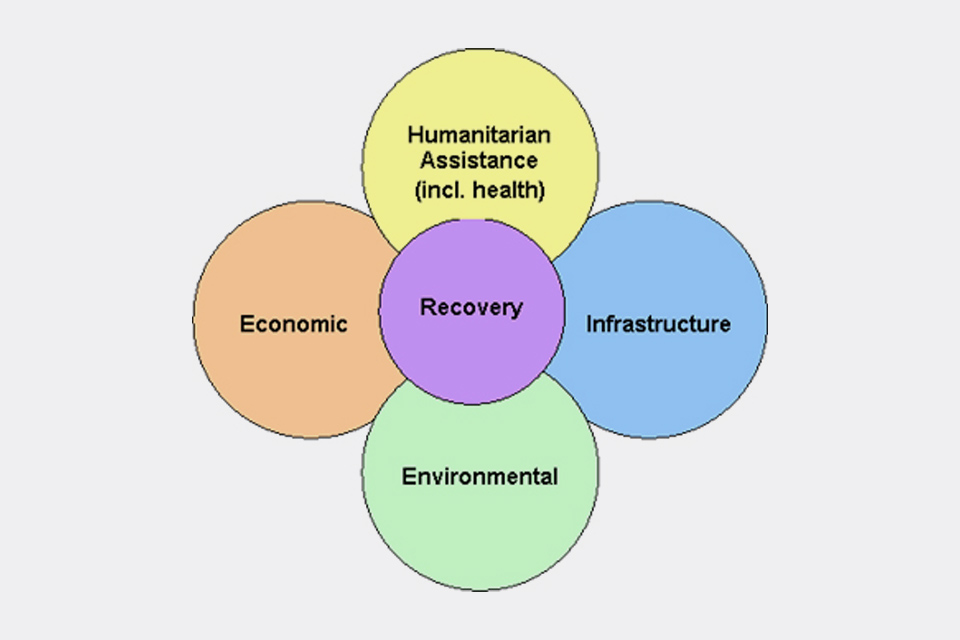
Diagram showing the structure of the Recovery Co-ordinating Group, with Humanitarian Assistance, Infrastructure, Environmental and Economic all feeding into the central Recovery Co-ordinating Group
Some examples of the types of issues that may be faced are as follows:
| Humanitarian assistance (including health) | Physical impacts (including individuals’ health, housing, financial needs) |
| Humanitarian assistance (including health) | Psychological impacts |
| Humanitarian assistance (including health) | Deaths |
| Humanitarian assistance (including health) | Community displacement |
| Economic | Economic and business recovery |
| Infrastructure | Disruption to daily life (eg. educational establishments, welfare services, transport system) |
| Infrastructure | Disruption to utilities / essential services |
| Infrastructure | Damage to residential properties and security of empty properties |
| Environmental | Pollution and decontamination |
| Environmental | Waste |
| Environmental | Natural resources |
Policy and guidance
There is no UK policy on how to carry out impact assessments during the recovery phase of an emergency. Guidance on the impact assessment process does exist for other specific purposes (eg. the police have guidance on the community impact assessment process for community cohesion issues), but this does not fully address the particular needs of community recovery. This is recognised as a gap and government is considering how this gap might be filled.
In the meantime, the following sections provide some general information about impact assessments and an example twelve step process that can be followed when conducting such assessments.
General
Impact assessment involves the systematic and co-ordinated collection and sharing of information about the overall size and scale of the impacts of an emergency. The establishment of the scale of an event is one of the most critical initial activities to be undertaken in an emergency situation.
To be effective, impact assessment requires a pre-determined strategy, which should include a combination of physical inspections and indicator contacts relevant to the event. A key aspect is establishing the limits of the affected area by establishing who is not affected. For a long duration event such as flooding, it can be an iterative process involving the sending out of initial assessments to others who may be able to add to the overall picture. Any such initial reports should clearly indicate where there are areas that have NOT been reported upon - these areas may or may not have been affected.
The earliest information regarding any emergency usually comes via telephone calls, at least from those who can get through to the authorities. It is easy to overlook areas without communications, and therefore not able to report their situation.
Where communications have failed or do not exist, the seeking out of information can only be done by some form of reconnaissance. Where ground reconnaissance cannot be undertaken due to ground access constraints, then aerial direct reconnaissance should be attempted or even higher-level photographic flights. Where this is not possible within a district, then requests can be made for national resources to be deployed.
It is important to carry out a community impact assessment as soon as possible to gauge the initial scale of the effect the incident has had on the community. It is vital to include businesses in this assessment as their state will have an enormous impact on the community as a whole. However, it should be recognised that the needs of businesses will often be significantly different from residents, so it may be appropriate to produce a separate business impact assessment alongside the wider community impact assessment.
The assessment will enable the Recovery Co-ordinating Group (RCG) to prioritise and resolve conflicting issues on what needs to be done within the resources available at the time. As part of the assessment process, the businesses that can best help the community to recover should be prioritised and addressed first. A food business, or a water provider for example, or another business that can directly help the community recovery (eg. due to the number of jobs it sustains), should be a high priority.
The RCG should decide what action is needed to improve the situation and monitor the progress on that action. The actions need to be SMART (Specific, Measurable, Achievable, Realistic and Time Based). The impact assessment is a continual cycle until the community has returned to normal or as close to normal as can be expected. The frequency of reassessment will gradually become longer until there is no longer any further benefit to be gained, or that the situation has been accepted or fully resolved.
The assessments would best be carried out by the specialist sub-groups of the main RCG.
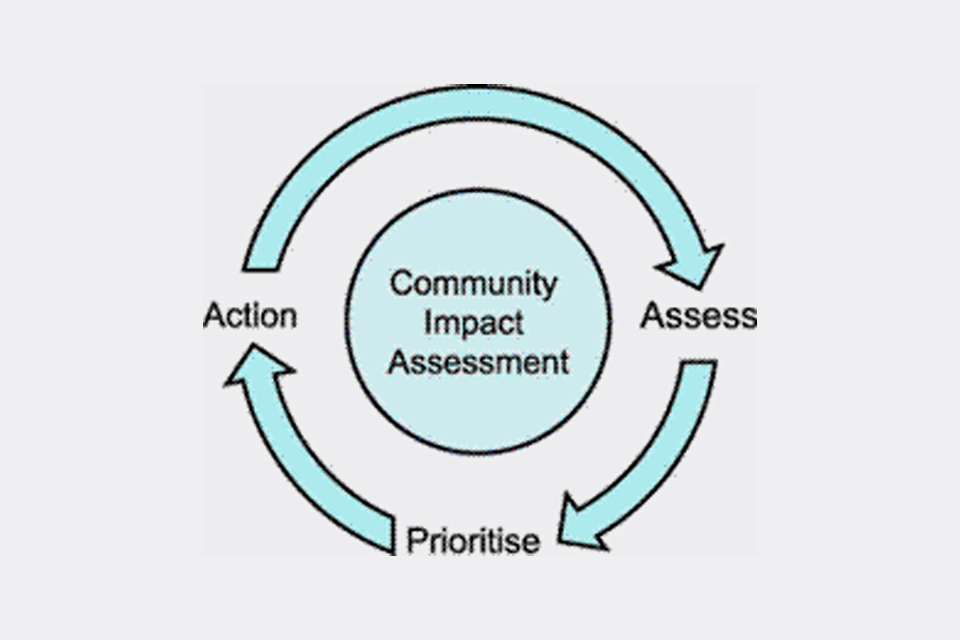
Diagram showing the steps in a community impact assessment - action, assess, prioritise
Steps for an impact assessment
There are a variety of impact assessment methods. An example of an approach to assess economic losses follows. The results can help selection of recovery options from consideration of hazards and vulnerabilities in the area, cost benefit analysis, and application of risk management. Each step does not necessarily need to be explicitly followed. The starting point should always be to identify the purpose of the assessment, but beyond that, progress will often be iterative, going back over the initial steps as more information emerges to modify what has already been assessed.
The steps are outlined as follows:
1.Identify the purpose of the assessment
Define what the assessment is intended to be used for, what problem(s) its results might address (immediate estimation (for response) or survey accurate for full recovery) and what level of accuracy it hopes to achieve (aggregation of jurisdictional areas or individuals/properties). There has to be a name and definition of the emergency in sufficient detail to define the area and time boundaries.
2.Organise consultation and information collection
No impact assessment can be successful unless a clear process has been set up beforehand to define and manage it. There has to be:
- a centre for operations and collecting/processing data
- a set work plan with milestones for consultation, assessment, feedback and final reporting
- a timeframe within which all this has to happen
Impact assessment involves input from many people and organisations and from assembled bodies of knowledge. This generally needs a committee made up of stakeholders to advise on the project. The consultation process not only means talking to people, but also covers setting up and running surveys, collecting and manipulating database information, and generally getting access to information in any form that would add value to the overall impact assessment.
3.Define the area and timeframe of the assessment
In any impact assessment there has to be a clear boundary within which the impact of the emergency of that area can be defined and evaluated. It is important to define the area being assessed, especially when estimating indirect losses and benefits in the form of insurance payouts and aid.
When defining the area of the assessment, make sure it represents the local economy affected by the emergency – not just a nominal space such as a convenient topographical line like a river. There are advantages in working to Local Authority or Parish/Town Boundaries as they are often the same boundaries that pre-event statistics, such as populations and economic returns, are based. Keep the study area in harmony with the time table for the assessment, and the extent of resources available to conduct it.
There also has to be a timeframe set to define how long after the emergency the assessment will be considering losses associated with it. Clearly, any assessment needs start and finish dates. Consider using a timeframe which is consistent with that of the response to, and of the recovery from, the hazard event. A flood event may use a timeframe of at least one to two years to fully assess indirect and intangible losses – unless indirect and intangible losses are judged to be unimportant in the emergency in question. As impact assessments will have to be reported during and after the emergency, consideration should be given to estimates of the likely indirect losses.
4.Select the type of assessment to be made
There are three commonly used approaches in assessing impacts after an emergency. They are:
- A rapid assessment, based largely upon pre-existing data for losses from similar previous emergencies – this is estimation from historic data – if relevant data exists.
- A synthetic approach, based upon modelled estimations of losses to model natural, built, social, and economic environments (e.g. using average building types and contents, population distributions, and economic models). Impacts are based on assumptions for the time or time-span of the event.
- A survey approach, where surveys are used to establish actual losses of the event being assessed.
Some combination of approaches could be used. The survey approach is commonly required for the post-event impact assessment – to enable effective recovery management. In selecting appropriate assessment methods, take account of the advantages and disadvantages of each method.
Inspections and Needs Assessments (surveys)
Where possible, surveys should combine inspections (making judgements from visual checks, such as whether a house may be safely reoccupied) with needs assessments (which involve interviewing affected residents). To cover both in a single visit to inform recovery management requires careful management and co-ordination. Much of the critical information will have been collected during more rapid response activities. Registration (the process of recovering personal details of those affected by the emergency) will have identified many of the affected people and safety inspections will have produced a list of damaged properties.
Inspections and needs assessments require the adoption of clear and consistent criteria for reporting so that accurate comparisons can be prepared. For example, an agreed definition would need to be reached as to when a property is said to be affected by flooding – is it if habitable areas were flooded, or if the garage was flooded, or if just the garden was flooded, etc? When data is to be collated over more than one local authority area (eg. during widespread flooding emergencies), it is even more important that clearly defined criteria are agreed and used by all – particularly if funding streams may flow from this.
Building inspectors, insurance assessors and environmental health officers are all likely to make inspections. The inspection process needs to be managed to ensure that priority tasks are completed first and that coverage is completed with efficient use of resources.
Allowance needs to be given to additional impacts that may follow the initial hazard event (eg. further rainfall or another high tide following a major flood, or the failure of a lifeline, such as a road, that survived the hazard event but then fails when it has to carry increased loads as other roads are not now available).
Surveys can be used to assist short-term recovery by:
- determining numbers, locations, circumstances and ethnicity of displaced and/or injured people
- assessing the safety of buildings for occupation and continued use
- assessing the state of lifeline utilities
- assessing the need for temporary works, such as shoring and temporary securing of property
- protecting property from unnecessary demolition
Inspections and needs assessments also contribute to longer-term recovery measures through:
- defining personal and community needs
- determining the aid and resources required for permanent recovery
- estimating the total cost of damage
- acquiring engineering, scientific and insurance data to inform the mitigation process
5.Obtain information about the hazard event
The aim of this part of an impact assessment is not to go into precise definition of the extent and characteristics of the hazard event but to focus on the key aspects in sufficient detail for the purposes of assessment. The starting point is generally a map, in whatever format best describes:
- the extent of the affected or assessed area
- the route of a moving hazard, such as a flood inundation or airborne contamination.
A map(s) would be supported by a wide range of source data such as:
- automated or manual field measurements during and after the emergency, such as flood depths and flow rates, projected rainfall
- photographs, television or private videotape records, eyewitness accounts
- reports on any other secondary impacts from the emergency, such as resulting contamination or building/infrastructure failures
6.Obtain information about the people, assets and activities at risk
Impact assessment is a measure of damage and disruption to assets and the effect this has on people and businesses in the affected and other areas. Environmental losses also may be important. Unfortunately, impact assessment sometimes has to measure the occurrence (where, who, how many) of death, injury and displacement resulting from the emergency.
A full list needs to be prepared in consultation with informed parties after an actual emergency. The outcome should be a database of everything likely to be affected by the hazard event.
7.Identify the types of impacts
In this step, the information derived in Steps 5 and 6 is used to separate impacts into categories, generally described as direct or indirect losses, and tangible or intangible. This helps define where the major impact components are likely to arise and what measurement techniques will be needed. Measurement techniques will depend on the approach selected in Step 4. Intangibles are often ignored, yet are frequently identified as the most significant losses by the people affected
8.Measure the extent of losses from all sources
This is where the counting of losses starts. Step 4 outlines the ways of addressing impact measurement in the survey, synthetic and averaging approaches to impact assessment, when looking at direct, indirect and intangible losses. Rather than grouping all losses by each category of loss (direct, indirect and intangible), it may be more practical to collate them by ‘loss sectors’, and determine indirect, direct and intangible losses for each sector at a time.
For example, in a typical flood emergency, loss sectors like these could be used to separate the items into study areas including residential, rural (including farming type, eg, dairy, horticulture, etc), industrial, cultural heritage, vehicles/boats, commercial (including retail, tourism and hospitality), infrastructure, environmental, etc.
9.Decide whether to count ‘actual’ or ‘potential’ losses
The use of actual or potential losses raises a number of issues for recovery management. For recovery, actual losses result from survey or direct indicators (eg. loss of retail activity); potential losses are forecasts – dependant on the degree of recovery achieved:
- Actual losses may discriminate against well-prepared communities if the loss assessment is used to decide on the worth of mitigation options.
- Actual losses may discriminate against poorer communities as they will typically have fewer assets and less economic activity to be damaged by a hazard.
- The difference between actual and potential losses will change considerably over time as people move and as other circumstances change.
10.Calculate Annual Average Damages (AAD) if needed
This step is generally useful for detailing the economic impact to a region and the required investment the recovery redevelopment and the disaster mitigation that can be economically justified (in terms of losses avoided on an average year, using an estimate of AAD. AAD is calculated by plotting loss estimates for a given hazard at a range of magnitudes, against the probability of occurrence of the hazard event
11.Assess benefits to region of analysis
Economic assessment measures the net loss to the economy in the area of analysis. To obtain net loss, any benefits to the economy resulting from the emergency need to be subtracted from the assessed losses. Assessment of benefits is particularly important within a regional context because post-event aid and insurance payouts will partly offset the tangible losses suffered, as the area of analysis becomes smaller. This step is only relevant for economic loss assessment
12.Collate and present the results of the loss assessment
Present the collated results of the impact assessment in a simple format, including maps and a table with assessments of different types of impact identified, together with any benefits from the emergency. A statement on the importance of intangibles should also be included to ensure they are not overlooked in recovery redevelopments and associated mitigation measures.
Key messages
Conduct vulnerability assessments pre-event to understand the likely consequences of impacts.
For recovery management, undertake an impact assessment post-event, based on actual damage as surveyed during the response and early stages of recovery.
Roles and responsibilities
Local and regional
Impact assessments will usually be led by the local authority, but with support from other relevant partners in the Recovery Co-ordinating Group and its sub-groups. For impact assessments focusing on the needs of business, the local authority may choose to work with the relevant Regional Development Agency in carrying out the assessment.
Lead Government Department
There is no specific Lead Government Department for impact assessments, although clearly many departments will have an interest in the results of any impact assessment that is carried out following an emergency.
Funding
Local authorities are expected to fund the costs of any impact assessment process.
Case studies (incidents and exercises)
Other useful documents
- The Buncefield Social Impact Assessment - Final Report [PDF] (and Annexes [PDF]), January 2007 was a study commissioned to draw together, from an external and independent point of view, the scale and range of the social impacts of the Buncefield incident.
- Disaster Emergency Needs Assessment [PDF] - International Federation of Red Cross and Red Crescent Societies, June 2000.
- Cornwall Council has developed an and accompanying . The Council is happy to share this with other councils or organisations who might find the tool helpful.
Contacts
[TBC]
Reporting
Background and Context
Recommendation 81 of the Pitt Review stated there should be ‘an agreed framework, including definitions and timescales for local-central recovery reporting’. The Government accepted this recommendation and has since been developing a standard mechanism for recovery reporting to ensure that there is a common understanding between Government departments, the Government Offices/devolved administrations, and local responders, about what will be expected in terms of reporting during the recovery phase.
Recovery reporting principles
In order to ensure that these arrangements are as consistent and as straightforward for local responders to use as possible, they all operate according to a set of . These principles have been agreed between the relevant government departments giving guidance as to how the reporting framework will be activated, and the processes in place to alert localities to its activation.
Recovery reporting framework
The recovery reporting framework is the formal mechanism for local authorities to report information on the recovery phase of an incident to central government, through the Government Offices. The information provided will be used by central government to inform ministerial decision making. The flow of information will be two-way and will also be collated and used to provide an overview of the national situation to the regions.
The recovery is intended to be fluid and responsive to needs and will be subject to change and improvement as we learn from real incidents.
Useful Links
- contains guidance on the recovery phase of emergencies, including reporting.
Voluntary sector
Background and context
Volunteers play a vital role in supporting the delivery of public services, whether it is in the community, health service or in schools. In the case of civil protection, a wide range of voluntary organisations, both at the local and national level, play an important role in preparing for and responding to emergencies by supporting statutory agencies.
Voluntary sector organisations are continually investing in planning and the preparation of their personnel to enable them to support Category 1 and 2 responders in emergency planning, response, recovery and resilience.
Civil Contingencies Act 2004
Civil contingencies legislation has been a significant development for the voluntary sector in clarifying its contribution to emergency planning and civil protection within the UK. The Act, Regulations and Guidance require Category 1 responders “to have regard” to the activities of voluntary organisations in the course of carrying out their emergency and business continuity planning duties. Voluntary sector organisations make their resources available to Category 1 and 2 responders through their Local Resilience Forum (LRF) / Strategic Co-ordination Groups.
Voluntary Sector Civil Protection Forum (VSCPF)
In order to provide a framework for engagement between Government, emergency services, local authorities and voluntary organisations, the Civil Contingencies Secretariat and the British Red Cross established the Voluntary Sector Civil Protection Forum in 2001. The Forum comprises representatives from the voluntary sector, central and local government, devolved administrations, statutory authorities and professional organisations.
The strategic aim of the Forum is to identify and maximise the voluntary sector contribution to UK civil protection arrangements.
The Forum and its associated working group undertake a variety of tasks which demonstrate the inter-dependency of the statutory and voluntary sector relationship in UK emergency planning, response, recovery and resilience arrangements.
UK policy and guidance
The VSCPF has done a great deal to inform the development of national policy on the role of voluntary organisations in civil protection, including:
- the development of legislative framework and its supporting statutory guidance (Emergency Preparedness), and their subsequent review
- the development of the supporting non-statutory guidance (Emergency Response and Recovery) and its subsequent review
- development of guidance on humanitarian assistance
- development of guidance on recovering from emergencies
- development of guidance on dealing with mass fatalities
- community Resilience Programme
- get Ready for Winter initiative
- the Civil Contingencies Act Enhancement Programme
Useful documents
Last updated 26 March 2013 + show all updates
-
New case study added.
-
First published.